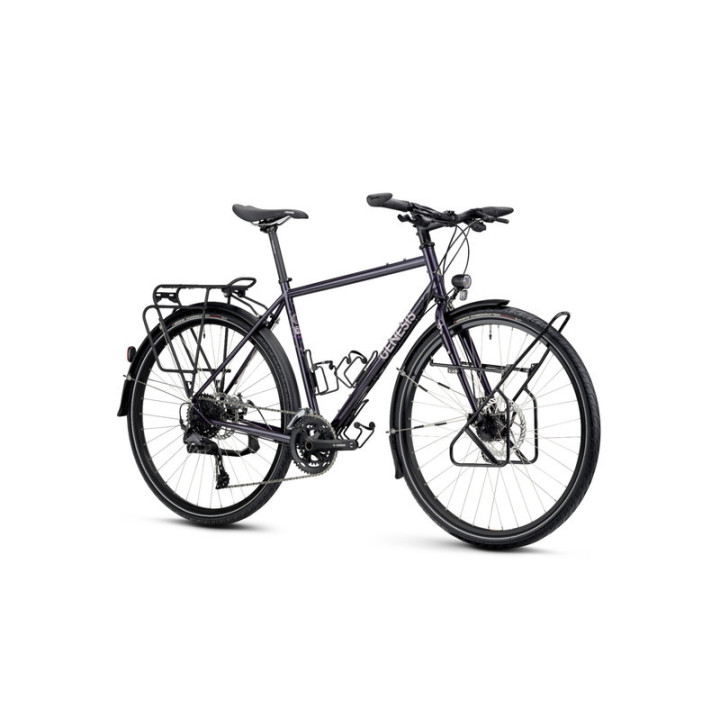
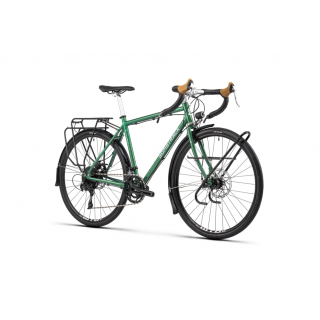
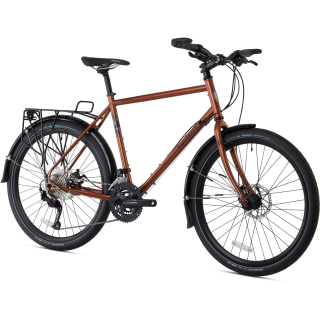
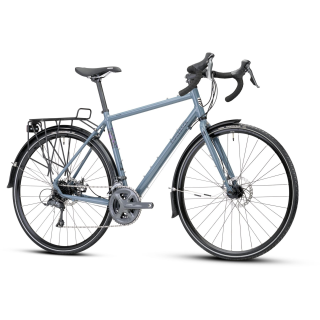
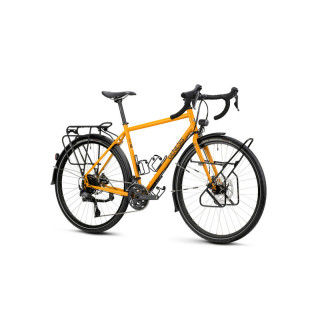
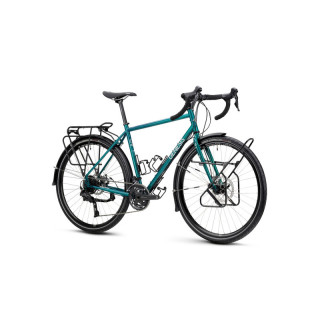
The Genesis Tour de Fer 30 is a fully equipped touring bike designed for real-world travel.
With a Reynolds 725 steel frame, new generation Shimano CUES drivetrain, dynamo lighting and integrated racks, it offers a reliable and self-sufficient platform for long-distance riding.
It’s built to be used straight away, without modifications.
Looking for a different size or variant? Get in touch to check availability and estimated delivery times: info@bikejamming.it
🌍International shipping available. If your country is not available at checkout, contact us at info@bikejamming.it to check availability and shipping options.
Secure payments and protected data
Secure & tracked delivery
Regulated and transparent withdrawal
Introduction
The Genesis Tour de Fer 30 is a touring bike designed to set off for real, with no modifications and no compromises.
Reynolds 725 steel frame, integrated dynamo lighting, front and rear racks, and a drivetrain designed for durability: it is a complete platform, built for riders travelling on tarmac and secondary roads with real luggage.
It is not a seasonal update, but an already mature configuration: everything is already in the right place.
Performance and real-world use
The Tour de Fer 30 is built for traditional cycle touring: long transfers, autonomy, reliability.
Its behaviour remains stable even when fully loaded thanks to the long chainstay (465 mm) and optimised weight distribution with the front lowrider.
The flat handlebar promotes a more open and less fatiguing riding position over time, while the components are selected to keep working even far from specialised workshops.
It is a bike that prioritises continuity of travel over pure performance.
Drivetrain and autonomy
The Shimano CUES 2x10 drivetrain introduces a very interesting balance between simplicity and gear range.
The 11–39T cassette combined with the 46/30T double chainset allows you to tackle climbs even when fully loaded, without giving up a good cruising speed.
The real difference, however, lies in the LINKGLIDE logic: greater durability and more consistent function over time, especially under load.
Dynamo and complete equipment
The Tour de Fer 30 is designed to be autonomous.
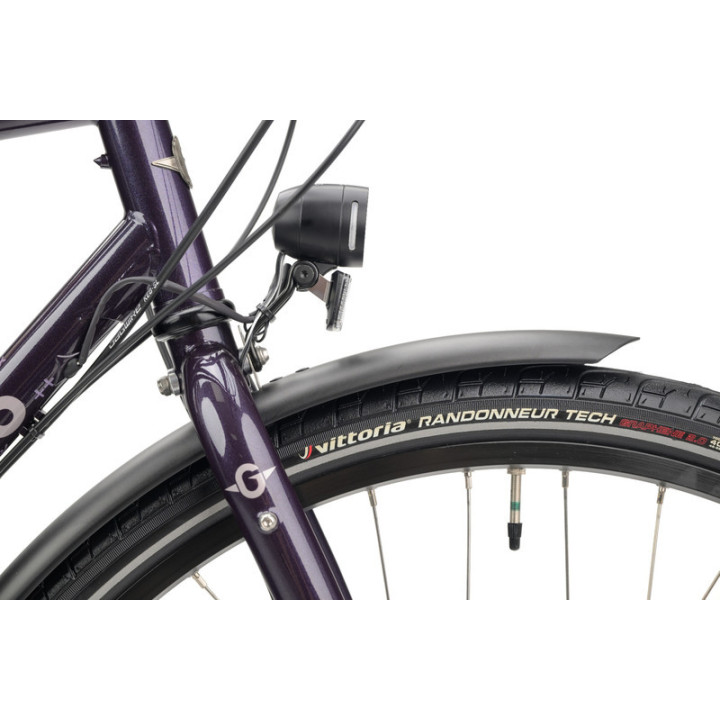
The Shimano dynamo hub powers the Busch & Müller lighting system, powerful enough to ride even away from the tarmac and in low-light conditions.
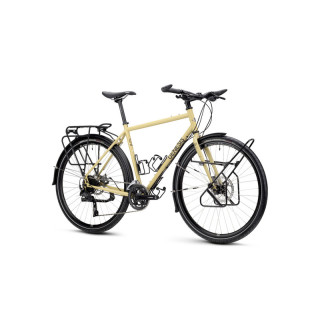
The front lowrider and rear AVS rack are already installed, along with mudguards: the bike is ready to travel from day one.
Reviews and positioning
The Tour de Fer has been one of the reference points in traditional cycle touring for years.
This configuration keeps that concept fully intact: reliability, ease of management, and the ability to handle long journeys without depending on upgrades or modifications.
It is a bike designed to be used, not optimised.
Size guide
XS: 156–164 cm
S: 164–172 cm
M: 172–180 cm
L: 178–186 cm
XL: 186–194 cm
These indications are approximate.
For a more precise choice, write to us with your height and inseam: reply within 24 hours.
CTA
If you are looking for a bike that is truly ready to travel, without having to build anything from scratch, the Tour de Fer 30 is one of the most complete platforms available.
Contact us for advice on the configuration best suited to your intended use.
Technical specifications
Frame
Reynolds 725 Steel Tubing
Fork
Genesis Chromoly Fork
Drivetrain
Shimano CUES U6000
Speeds
2 x 10-speed
Chainset
46/30T Chainrings
Cassette
11-39T Cassette
Handlebar
Amplitude F100 Flat Handlebar
Seatpost and stem
Amplitude G100 Seatpost & Stem
Saddle
Madison Flux Switch Saddle
Rims
Sun Ringle Rhyno Lite Rims
Front hub
Shimano Dynamo Front Hub
Axles
QR Front & Rear
Tyres
Vittoria Randonneur Tech 700 x 40 mm Tyres
Brakes
Promax DSK-717 Mechanical Disc Brakes
Rotors
180 mm Front & 160 mm Rear Rotors
Accessories
AtranVelo AVS Rear & Lowrider Front Racks Busch & Muller Dynamo Light Set
Geometry
Size
XS
S
M
L
XL
Top Tube
543
557
569
584
600
Reach
380
380
390
400
410
Stack
566
580
603
622
641
Head Angle
70.5
70.5
71.5
71.5
71.5
Seat Angle
74
73
73.5
73.5
73.5
Chainstay
465
465
465
465
465
Wheelbase
1072
1077
1085
1101
1117
FAQ – Genesis Tour de Fer 30
Is the Genesis Tour de Fer 30 suitable for long journeys?
Yes. That is exactly what it is designed for: long-distance cycle touring with full luggage. Stable frame, racks already included, and reliable components make it ready to go without modifications.
What is the difference between the Tour de Fer 20 and 30?
The main difference lies in the equipment. The Tour de Fer 30 integrates dynamo lights, more robust rims, and a configuration more focused on autonomy during long trips. The 20 is more essential, while the 30 is already fully equipped.
Is the dynamo really useful?
Yes, especially for travel. It gives you always-available lighting without having to recharge batteries. It is a reliable solution and particularly useful over long distances or in variable conditions.
Is it also suitable for everyday use?
Yes, but it is built for travel. It can be used for commuting or urban mobility, but its strength lies in stability and load management rather than lightness or reactivity.
What kind of terrain is ideal for the Tour de Fer 30?
Tarmac, compact gravel roads, and mixed routes. It is not designed for technical trails or demanding off-road riding: it is a traditional touring bike, efficient and stable.
Is the flat handlebar a limitation on long trips?
It depends on personal preference. The flat bar offers a more open and intuitive position, often more comfortable for many riders, especially on steady-paced trips. Riders who prefer more hand positions may consider other configurations.
Do I need to modify anything before setting off?
No. It is already a complete bike: racks, lights, drivetrain, and components are selected to be used from the outset.
How do I choose the right size?
Height-based indications are a useful starting point, but not always enough. For a more precise choice, it is helpful to consider inseam and body proportions as well.
You can write to us with your measurements: we will help you choose the most coherent configuration.



Comments (0)
Your review appreciation cannot be sent
Report comment
Report sent
Your report cannot be sent