
- 1x, 2x or Rohloff: What Really Matters
- Touring Drivetrain: Context Before Technology
- 1x, 2x or Rohloff: Practical Differences, Not Ideological Ones
- Gear Range and Development: What Really Matters
- Drivetrain and Load: How Choices Change
- Concrete Examples of Coherent Choices
- Reliability and Availability: The Real Divider
- When Complexity Makes Sense
- Conclusion
- FAQ – Drivetrain and Travel
1x, 2x or Rohloff: What Really Matters
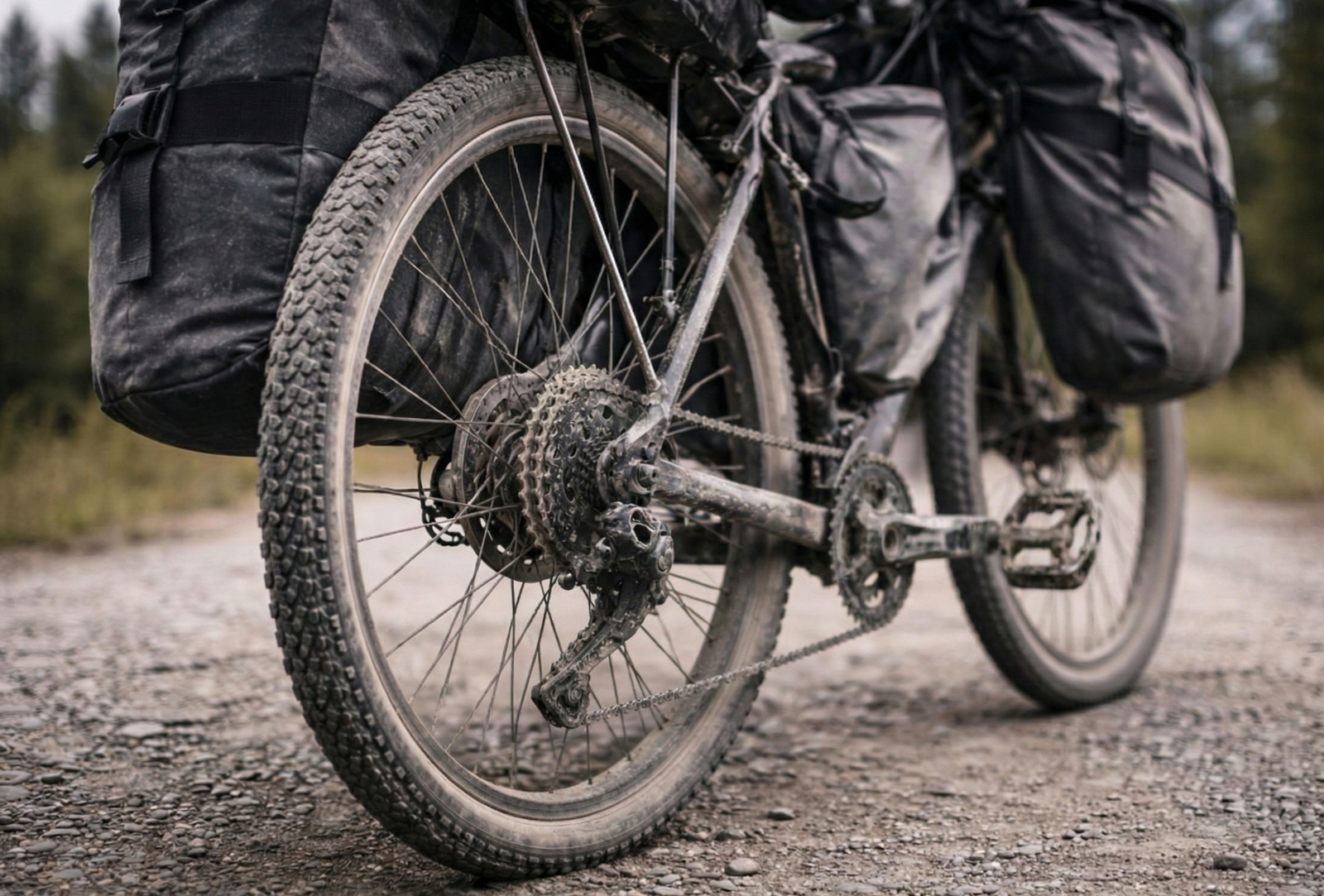
When it comes to touring bikes, the drivetrain is one of the most underestimated elements in the initial decision — and one of those that, in real-world use, makes the clearest difference between a smooth journey and a tiring one.
1x or 2x.
Traditional derailleur or internal gear hub like Rohloff.
Huge cassette range or closer gear steps.
The problem is not the lack of options, but the fact that the same solutions are often evaluated outside the real context of travel.
On a journey, the drivetrain is not there to “perform.”
It is there to keep working — day after day — under load, fatigue and less-than-ideal conditions.
Touring Drivetrain: Context Before Technology
A touring drivetrain is not chosen in isolation (the complete method for evaluating a bicycle as a whole is explored in depth in Travel Bikes – A Guide to Choosing).
It is chosen according to three factors that work together:
-
type of route
-
load (how much, and for how long)
-
continuity of stress
A bike travelling on asphalt with constant load requires a different drivetrain from one tackling irregular gravel, repeated accelerations and variable gradients.
Both are different again from a bike built for weeks of remote tracks with structural load.
1x, 2x or Rohloff: Practical Differences, Not Ideological Ones
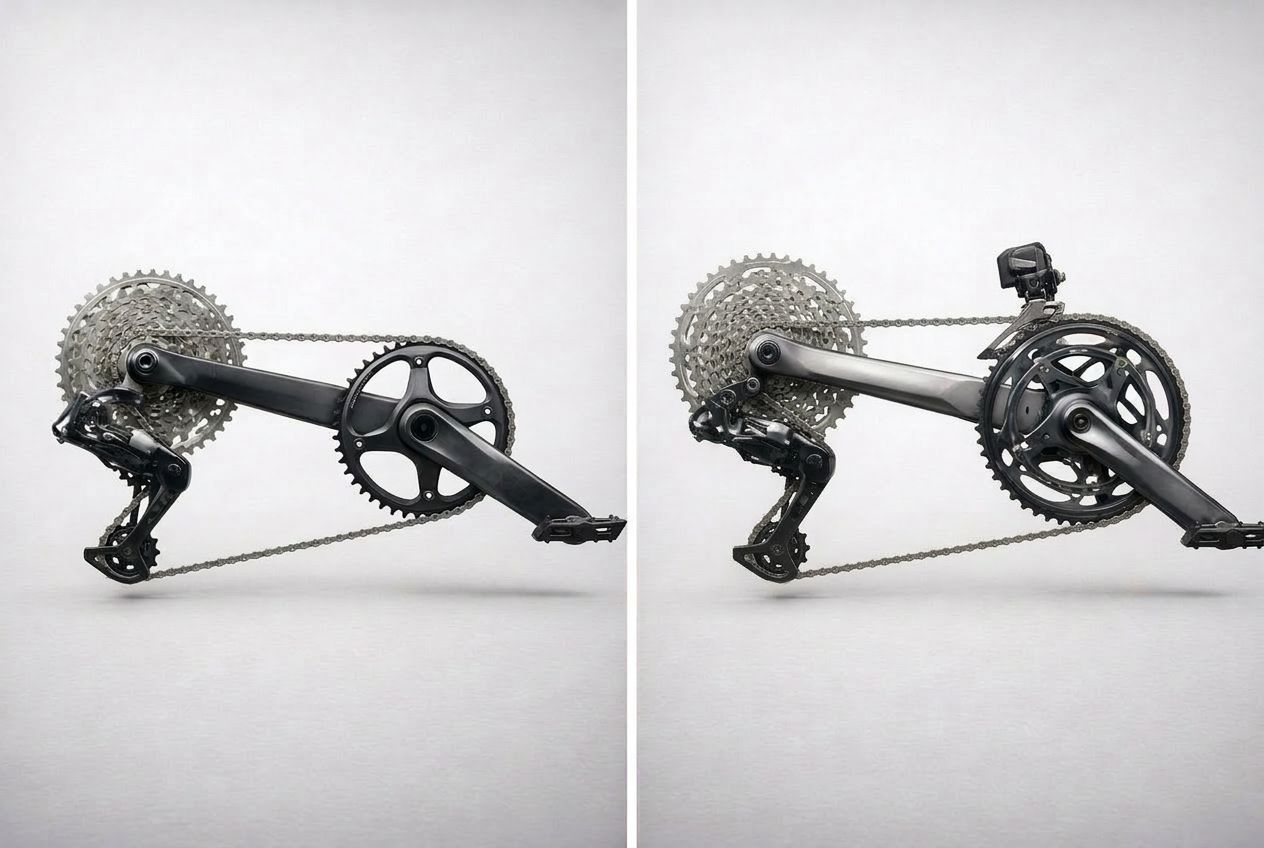
2x: When Continuity Matters More Than Simplicity
A double chainring remains extremely effective for asphalt touring and smooth surfaces, especially under load.
The real advantage is not the number of gears, but progression:
closer gear steps allow you to maintain a steady cadence for hours, reducing fatigue.
Concrete example:
on a touring bike with rear panniers, riding 6–8 hours on gently rolling asphalt becomes far more manageable if gear changes are small. Here, 2x works quietly in the background.
It is not outdated.
It is coherent.
1x: Control and Simplicity on Variable Routes
A single chainring works very well when:
-
terrain changes frequently
-
rhythm is inconsistent
-
the priority is reducing adjustments and complexity
On mixed-terrain travel or advanced bikepacking routes, 1x allows you to focus on riding and terrain.
Its limits appear mainly on asphalt with constant load, where larger gaps between gears can make it harder to find the “right” cadence.
1x is not a compromise — it is a logical choice when the route demands it.
Rohloff: When the Drivetrain Becomes Structural
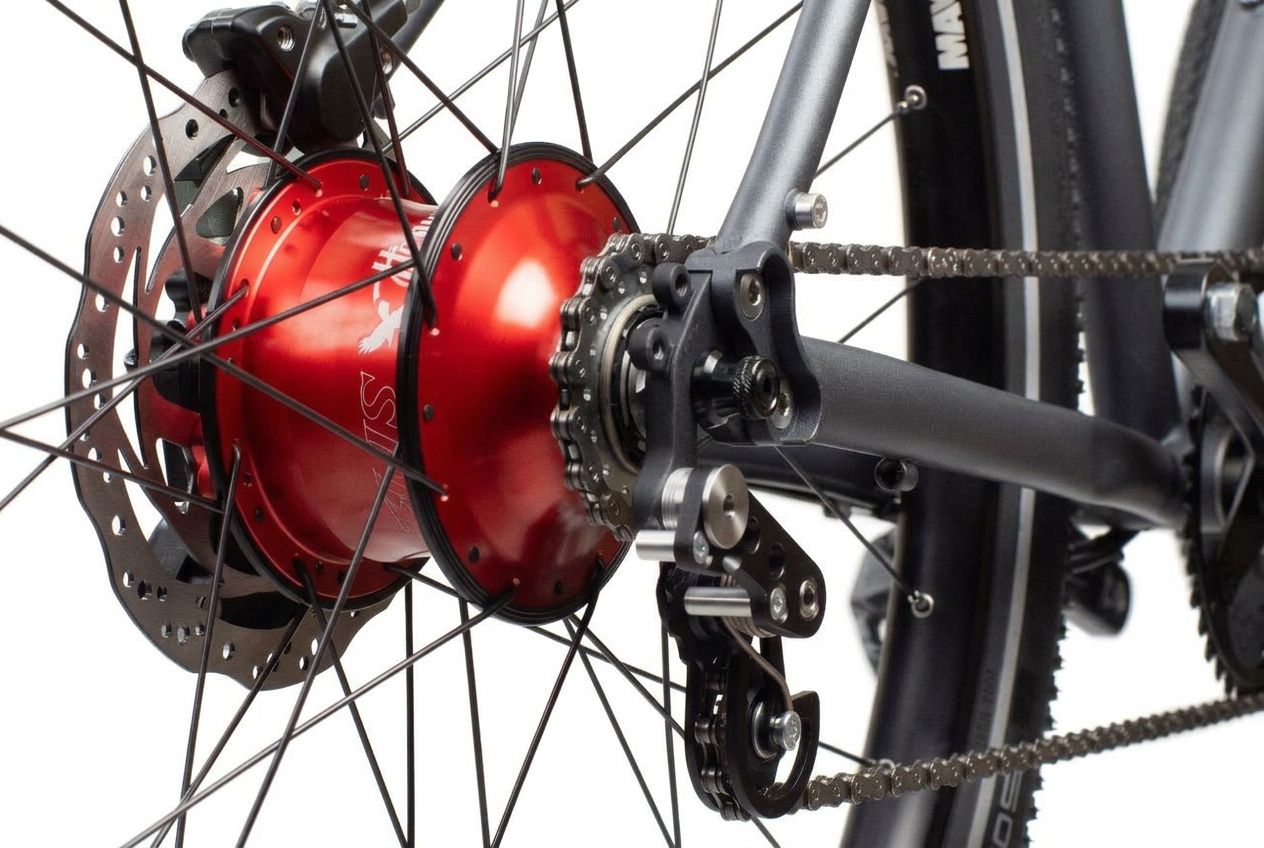
Rohloff is not a “better” drivetrain.
It is a different one.
It makes sense when:
-
the load is structural
-
the journey is long and repeated
-
maintenance must be minimal
-
the drivetrain must always work, even under stress
On heavy-duty travel with significant load and irregular terrain, Rohloff offers continuity of function that traditional systems can only match with greater attention and maintenance.
It is not universal.
It is coherent for certain journeys.
Precisely because a Rohloff setup involves the frame, wheel, chainline, gearing, and overall bike compatibility, it’s often best considered as part of a dedicated build rather than a simple standalone upgrade.
→ Learn more about touring wheel and hub configurations (SON, Rohloff, and bikepacking)
Gear Range and Development: What Really Matters
This is often the most misunderstood point.
In travel, theoretical range matters less than usable gear development, which also directly affects comfort and pedaling continuity, a topic closely intertwined with tire pressure and tire width management in travel (see Tyres and Comfort — Guide)
In simple terms, gear development is the distance travelled with each pedal revolution.
On a journey, you need:
-
a genuinely low gear to climb under load without forcing
-
a comfortable middle range for hours of riding
-
rarely, if ever, an extremely high “speed” gear
Practical example:
a loaded bike climbing a sustained 6–8% gradient does not need a sporty gear — it needs a ratio that allows you to spin when you are already tired.
If your lowest gear is “just enough,” it becomes insufficient in real travel conditions.
This is why, often:
-
a slightly narrower but well-used range
is better than -
a huge range with extreme gears that are rarely usable
Drivetrain and Load: How Choices Change
Load radically changes how a drivetrain behaves.
With light and variable load:
-
compromises are easier to accept
-
1x works very well
-
gear gaps are less critical
With continuous structural load:
-
genuinely low gears become essential
-
progression matters more than the number of speeds
-
the drivetrain constantly works under torque
This is where the difference emerges between a drivetrain that is “suitable” and one that is merely “functional.”
Many travel-oriented projects from brands such as Genesis, Bombtrack, Surly and Jamis are built around this logic: reliable, predictable solutions that remain manageable over time.
Concrete Examples of Coherent Choices
Asphalt Touring with Continuous Load
2x drivetrain with well-spaced gears and genuinely low development.
Priority: smooth progression, steady cadence and reduced fatigue on long days.
Mixed Travel / Advanced Bikepacking
1x drivetrain with a well-chosen cassette and sufficiently low climbing gear for variable loads.
Simplicity, control and adaptability matter more than absolute refinement.
Adventure and Heavy-Duty Travel
Rohloff or very robust drivetrains with truly low ratios.
Reliability, continuity and the ability to function under stress come first.
Reliability and Availability: The Real Divider
In real travel, the drivetrain must:
-
tolerate dirt and wear
-
be adjustable without specialist tools
-
use widely available components
Often, less fashionable solutions win here — because they are robust and widespread.
In travel, perceived reliability matters less than actual reliability. Many mistakes stem precisely from a superficial evaluation of the drivetrain, as explained in Common Mistakes in Choosing a Travel Bike.
When Complexity Makes Sense
It makes sense to choose a more complex drivetrain when:
-
the route genuinely requires it
-
the benefit is constant, not occasional
-
the added complexity reduces other problems
It does not make sense when:
-
the choice stems from theoretical comparison
-
the advantage is marginal
-
maintenance becomes a burden
On a journey, the right drivetrain is the one you stop noticing after the first day.
Conclusion
The ideal drivetrain for a touring bike is not the most discussed, nor the most technological.
It is the one that:
-
allows you to climb without forcing
-
maintains a natural cadence for hours
-
continues working when you are tired, loaded and far from home
When that happens, the drivetrain has done its job.
FAQ – Drivetrain and Travel
Is 1x or 2x better for a touring bike?
It depends on the route. 2x works very well on asphalt with continuous load; 1x is ideal on mixed and variable terrain.
Is Rohloff always the best choice for travel?
No. It is highly coherent for long journeys with structural loads, but neither necessary nor ideal in every scenario.
Does range matter more than gear development?
Usable gear development matters more. A truly low climbing gear is worth more than a huge theoretical range.
Why are low gears so important in travel?
Because they allow you to climb under load without forcing when fatigue is already present. On a journey, you pedal tired — not fresh.
Is a simpler drivetrain always better?
It is better when it reduces real-world problems. Simplicity is valuable only if it improves reliability and long-term manageability.
Can I change the drivetrain later?
Partly, yes. But some choices — such as Rohloff or certain gear ranges — should be evaluated at the frame design and intended-use stage.