
- How to Choose Based on the Real Route
- A Technical Criterion for Choosing a Touring Bike
- The Four Factors That Determine the Choice
- Three Travel Logics, Not Three Labels
- Gravel or Touring Bike?
- The Frame: What Remains When Everything Else Changes
- Drivetrain, Tyres and Suspension
- A Technical Choice, Not an Ideological One
- Frequently Asked Questions About Choosing a Touring Bike
How to Choose Based on the Real Route
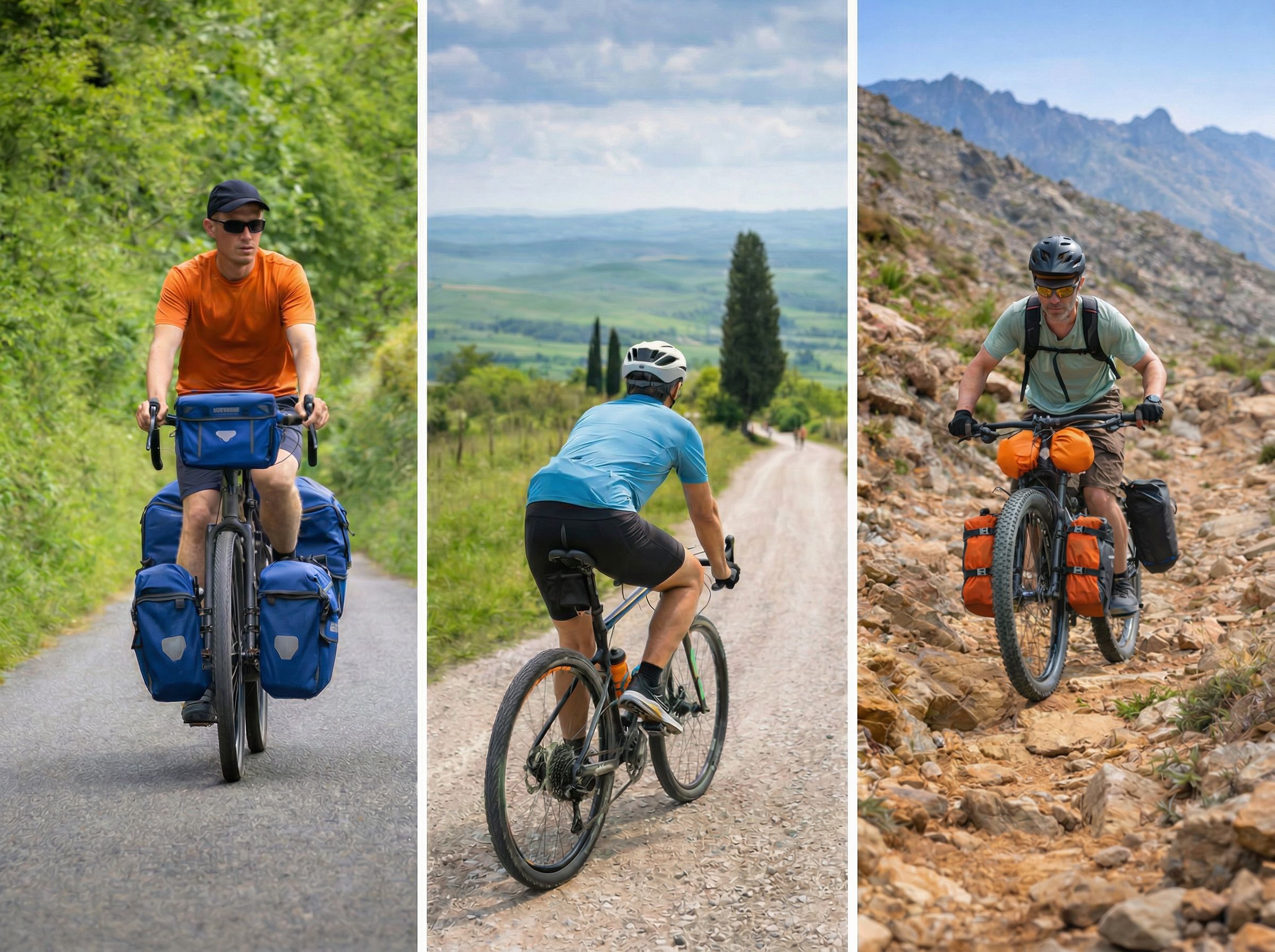
In contemporary cycling, the expression touring bike is used very loosely. The same definition is applied to bicycles designed to cross countries on asphalt with panniers, to move across mixed terrain with minimal luggage, or to tackle remote, isolated and demanding tracks, even with relatively light loads.
From a technical perspective, these scenarios are not interchangeable. Yet many wrong choices stem precisely from this overlap.
If you are wondering which touring bike to choose, the answer does not start from the model but from the type of route you will actually face most of the time.
The first point to clarify is simple: there is no universal touring bike. There are bicycles that work well in relation to a certain type of route and a specific level of prolonged stress.
To truly orient yourself, you need a more solid criterion than commercial labels.
Explore available touring bikes and frames
- → Browse all touring and cycle touring bikes
- → Explore frames for touring bikes and gravel touring
A Technical Criterion for Choosing a Touring Bike
Before talking about frames, components or luggage systems, it is useful to pause on a technical question, not an ideological one: what type of terrain and conditions will I face most of the time?
This is not about excluding future possibilities. A coherent initial choice does not limit a more ambitious journey: it makes it feasible.
Many mistakes arise from thinking in terms of category instead of real terrain, load and continuity of stress. Every surface generates different stresses and requires different responses from the bike.
It is not just a matter of comfort: torsional loads on the frame change, weight distribution shifts, the frequency of micro-corrections at the handlebar increases, and the type of traction required from the rear wheel differs.
For a more specific analysis you can also read Common Mistakes When Choosing – Touring Bike.
The Four Factors That Determine the Choice
Predominant Surface
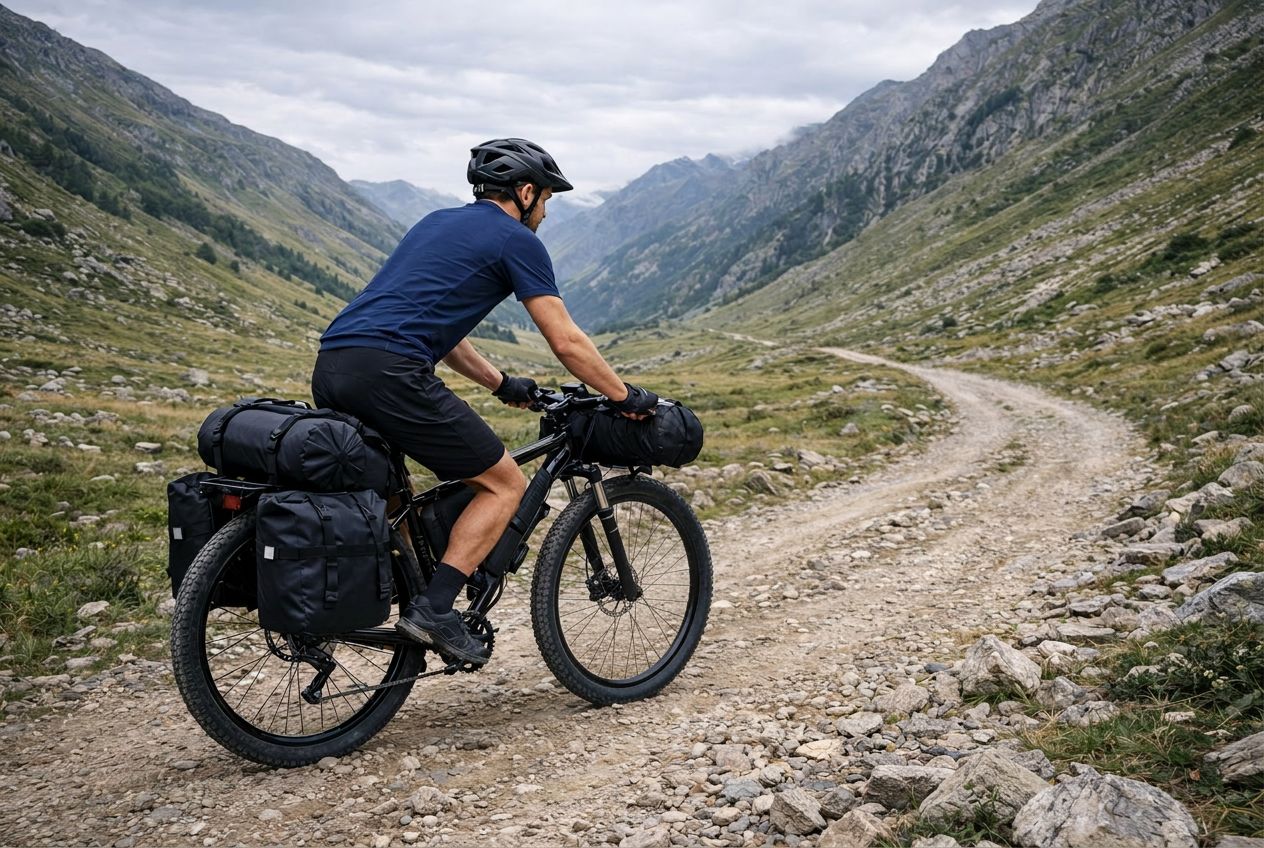
Riding mainly on asphalt and secondary roads is very different from alternating asphalt and regular gravel, or from moving across continuous rough terrain, deteriorated tracks and remote routes.
A journey with 80–90% asphalt and continuous load requires directional stability and consistency. A mixed journey requires balance and adaptability. A journey on continuously rough terrain requires robustness and structural coherence under stress.
Continuity of Stress
In real travel, a bike does not just need to work for an hour. It must work for consecutive days, without requiring constant compensations from the rider.
A geometry that feels balanced on a three-hour ride can become fatiguing after five consecutive days with constant load.
Nature of the Load
Asking “bikepacking or traditional panniers?” only makes sense after clarifying this point. To explore the logic of load systems in more depth, you can read Touring Bike Bags – Selection Guide and Load Distribution – Guide.
Evolution Over Time
A good touring bike is not the one that is perfect in abstract terms, but the one that remains coherent as usage grows and changes.
Three Travel Logics, Not Three Labels
Classic Touring on Predominantly Asphalt
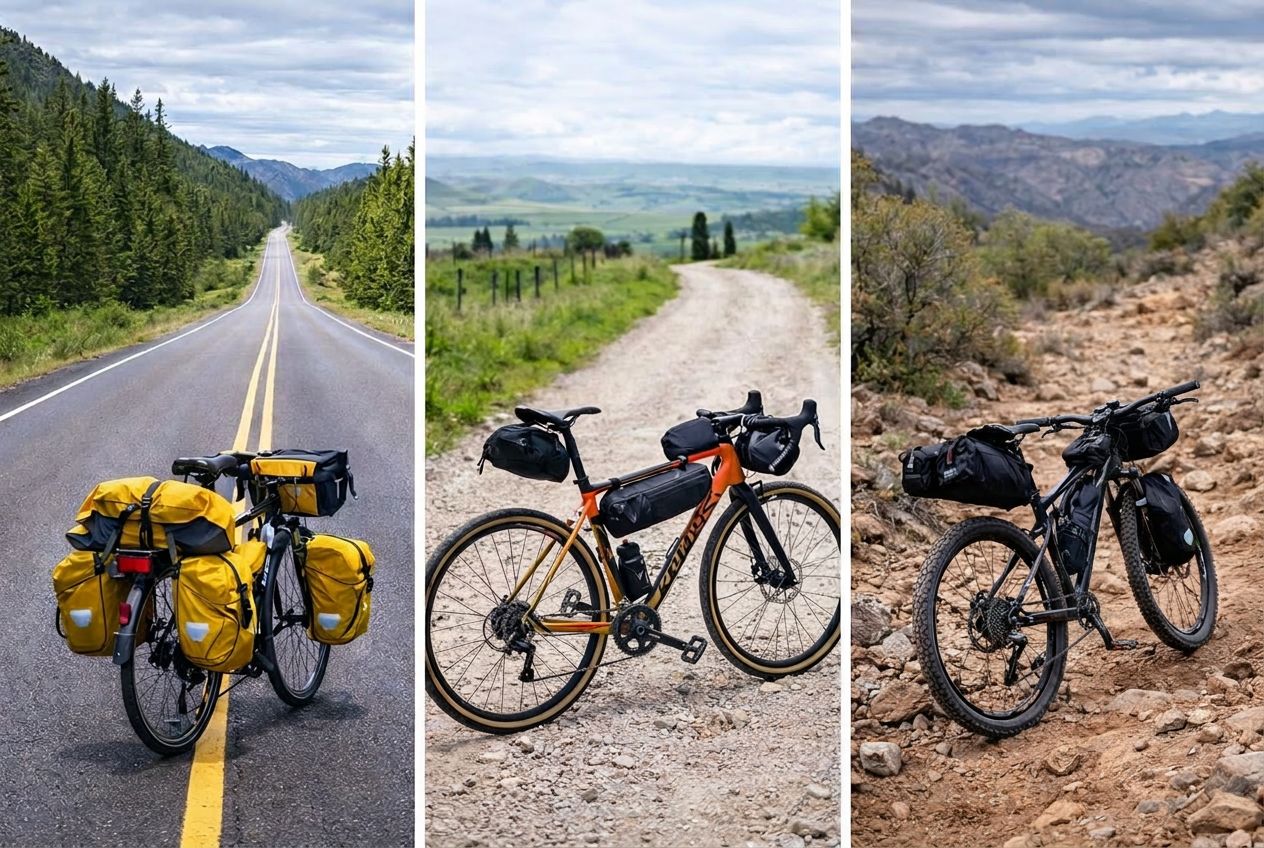
If your journey is mainly on asphalt with panniers permanently mounted, a stable touring platform is often more coherent than an extreme adventure bike.
Mixed Travel and Advanced Bikepacking
To better understand the differences between categories, you can read Adventure, Gravel or Touring?.
Adventure and Heavy-Duty Travel
A longer wheelbase, a stable rear triangle and a platform designed to work under continuous stress are required.
In these contexts, torsional stiffness of the fork and load distribution between front and rear become decisive.
In these scenarios, predictability matters more than reactivity: a bike that is too nervous under load becomes mentally exhausting before it becomes physically demanding.
If you are considering front load and a dedicated fork, you can also read Front Load – Guide.
These three approaches correspond to different platforms, each designed to perform in specific conditions.
- → Adventure touring bikes for structural loads and demanding routes
- → Gravel & all-road bikes for mixed terrain and variable loads
- → Classic touring bikes for asphalt travel with consistent load
Gravel or Touring Bike?
One of the most common questions is: is a gravel bike or a touring bike better for travelling?
The answer depends on the real route.
For predominantly asphalt journeys with continuous load, a stable touring bike is often more efficient and less fatiguing.
For mixed journeys with light and variable load, some well-balanced gravel bikes can be a very valid choice.
For journeys with structural load and demanding terrain, you need a platform designed to work under stress.
The difference is not in the name of the category, but in the ability of the geometry to remain predictable when the centre of gravity shifts.
For mixed routes and variable loads, you can look towards a gravel or all-road bike, while for asphalt travel with continuous load, more traditional classic touring platforms remain more coherent.
→ View available gravel bikes
The Frame: What Remains When Everything Else Changes
A good touring frame remains stable under load even when components and configuration evolve over time.
This depends on the balance between head angle, chainstay length, wheelbase and stack: parameters that cannot be “compensated” with aftermarket components.
To better understand how geometry affects stability under load, you can read Touring Bike Geometry – Guide.
If you are considering a modular setup or planning to build your bike over time, you can start with a touring bike frame aligned with your intended use.
Drivetrain, Tyres and Suspension
Comfort comes first from the tyre, not from the suspension. Actual tyre volume and correct pressure often have more impact than a suspension fork mounted on a platform not designed to work with front weight.
The drivetrain comes into play when terrain becomes variable or demanding: proper gearing allows you to maintain cadence and control under load, reducing strain on legs and joints during long climbs and over rough surfaces.
If you want to go into technical detail, you can read Touring Bike Drivetrain – Selection Guide and Tyres and Comfort – Guide.
A Technical Choice, Not an Ideological One
Choosing a touring bike means building coherence between real route, frame, geometry, load and build.
The right bike is not the one that promises to do everything. It is the one that keeps working when the journey becomes long, repetitive and real.
To see how these principles translate into real-world setups, you can explore the available touring bikes or start from a touring bike frame and build your setup progressively.
Frequently Asked Questions About Choosing a Touring Bike
Which touring bike should I choose for a long trip with panniers?
If the load is continuous and the terrain predominantly paved, a touring bike with stable geometry, balanced wheelbase and proper load distribution mounts is often the most coherent choice. A platform that is too sporty can become fatiguing in the long term.
Gravel or touring bike for travelling?
It depends on the real route. Well-balanced gravel bikes work well on mixed routes with light or variable load. For asphalt journeys with panniers always mounted, a touring bike is generally more stable and less nervous under continuous load.
Is there a touring bike suitable for everything?
No. There is no universal bike. There are bicycles designed to work well in specific scenarios. Looking for a bike “that does everything” often leads to a platform that does not truly excel in any context.
How do I choose a touring bike for asphalt and gravel?
You need a balanced platform, with adequate tyre clearance and stable geometry under load. The goal is to find a bike that does not become unstable on asphalt with panniers and does not feel nervous when the surface turns mixed.
How important is geometry in a touring bike?
Very. Wheelbase, chainstay length, head angle and position determine stability, control and fatigue more than total bike weight. Geometry is what allows the bike to remain coherent under load.
Is bikepacking always the best choice?
No. It works very well with variable loads and mixed routes. When the load becomes structural and continuous, more stable and distributed solutions can prove more efficient in the long term.
Does a touring bike need to be heavy?
Not necessarily, but bikes designed for continuous load are often more robust because they are built to work under stress. With significant loads, stability and reliability matter more than a few hundred grams saved.
Can I start with one bike and adapt it over time?
Yes, if the starting platform is coherent. The best touring bikes are those that can evolve without losing stability and predictability under load.