
Correlation Between Frame Geometry and Surface Type
A bicycle’s handling is determined by the balance between directional stability and maneuverability. These two aspects are not absolute opposites: they become more or less important depending on three factors that constantly change in real-world travel.
- speed
- surface quality
- stress continuity (hours or consecutive days of riding)
An effective geometry is not the most “extreme” one, but the one that is coherent with the terrain and with the bike’s real use.
Regular Surfaces (Asphalt and Compact Terrain)
On compact surfaces, the priority is efficiency: the bike must respond quickly to rider inputs and maintain a precise line even at higher speeds.
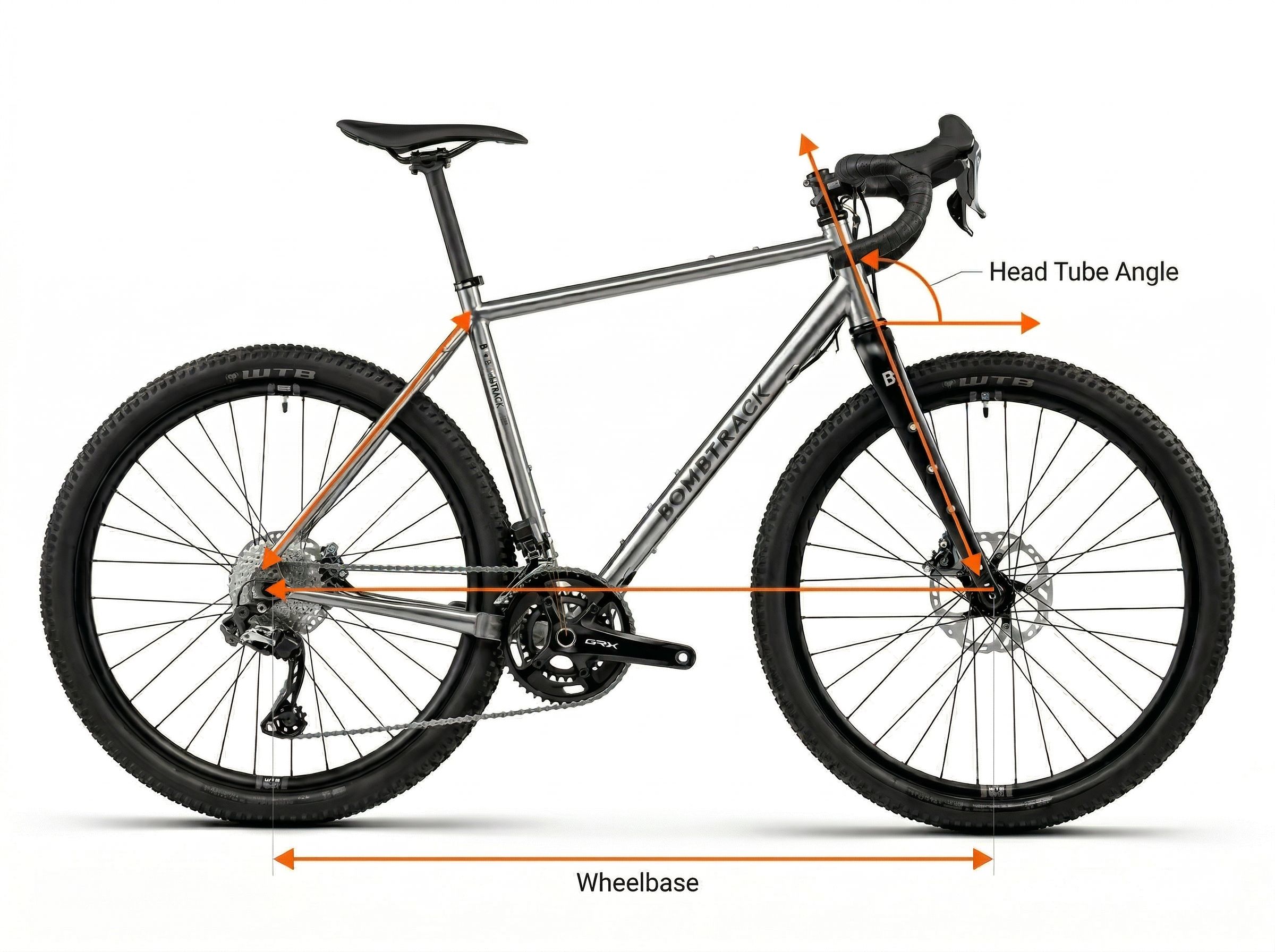
Head Tube Angle
Typically more upright (~72°–74°).
Main effects:
- faster steering
- greater precision in direction changes
It is important to remember that head angle alone does not determine stability: real behaviour depends on the final value of trail.
Wheelbase
A shorter wheelbase tends to make the bike:
- more responsive
- more agile in direction changes
- more efficient for sporty riding
On the other hand, it increases sensitivity to surface irregularities.
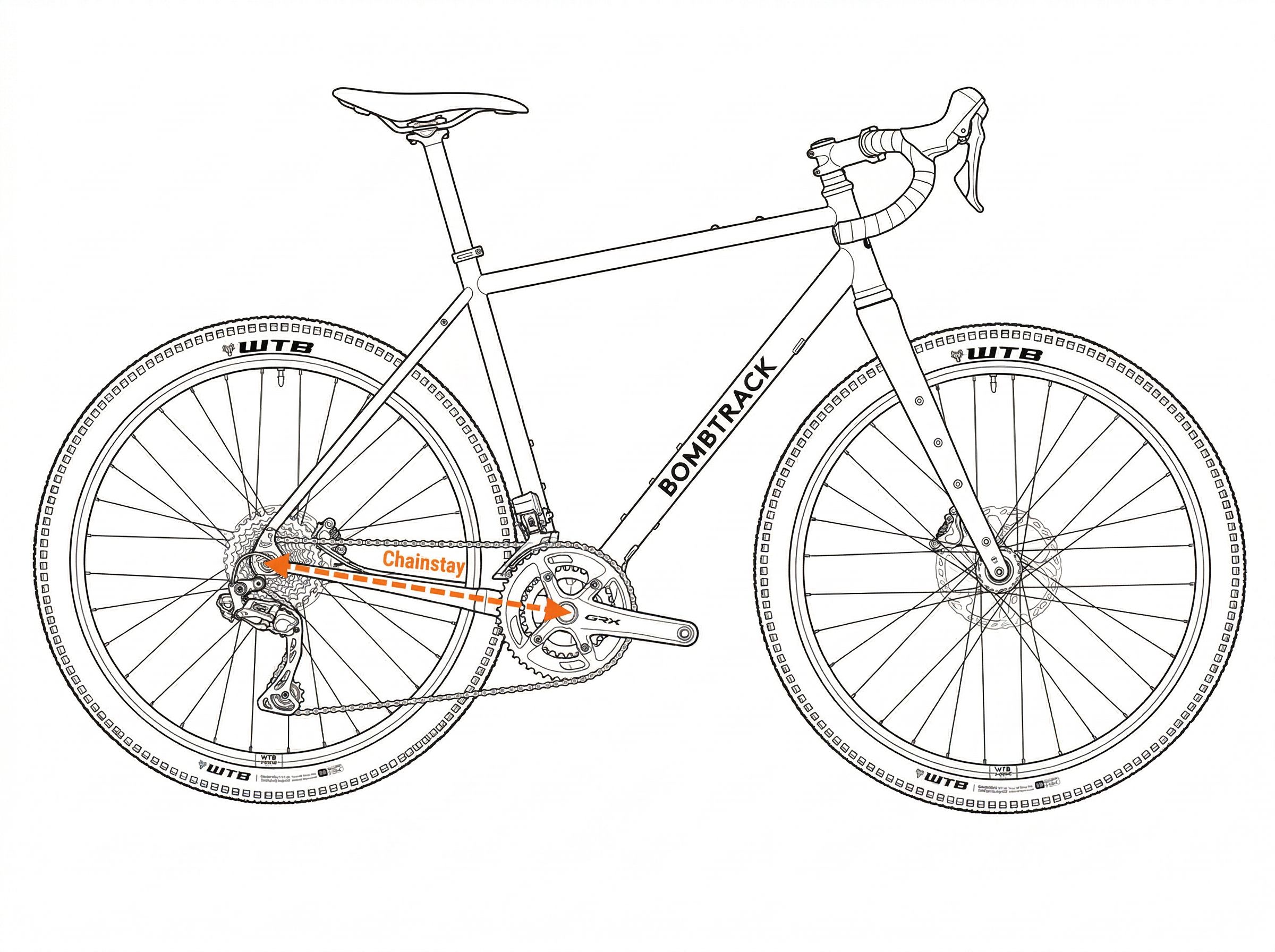
Chainstay Length
Shorter chainstays:
- make the bike more reactive under acceleration
- create a more immediate “snap” sensation
- concentrate weight closer to the centre of the bike
On perfect surfaces, this increases the liveliness of the ride.
Irregular and Rough Surfaces (Gravel and Off-Road)
When the surface becomes unstable — loose gravel, forest roads, degraded dirt tracks — the bike must handle continuous perturbations that tend to deflect the trajectory.
Here the priority changes: you do not need a “fast” bike, but a predictable one.
Slacker Head Angle
Typically ~69°–72° on off-road-oriented bikes.
A slacker head angle tends to increase trail, making the front end:
- more stable
- less nervous
- more self-centring
Longer Wheelbase
A longer wheelbase:
- improves directional stability
- makes the bike less sensitive to weight shifts
- increases confidence on descents over unstable terrain
BB Drop
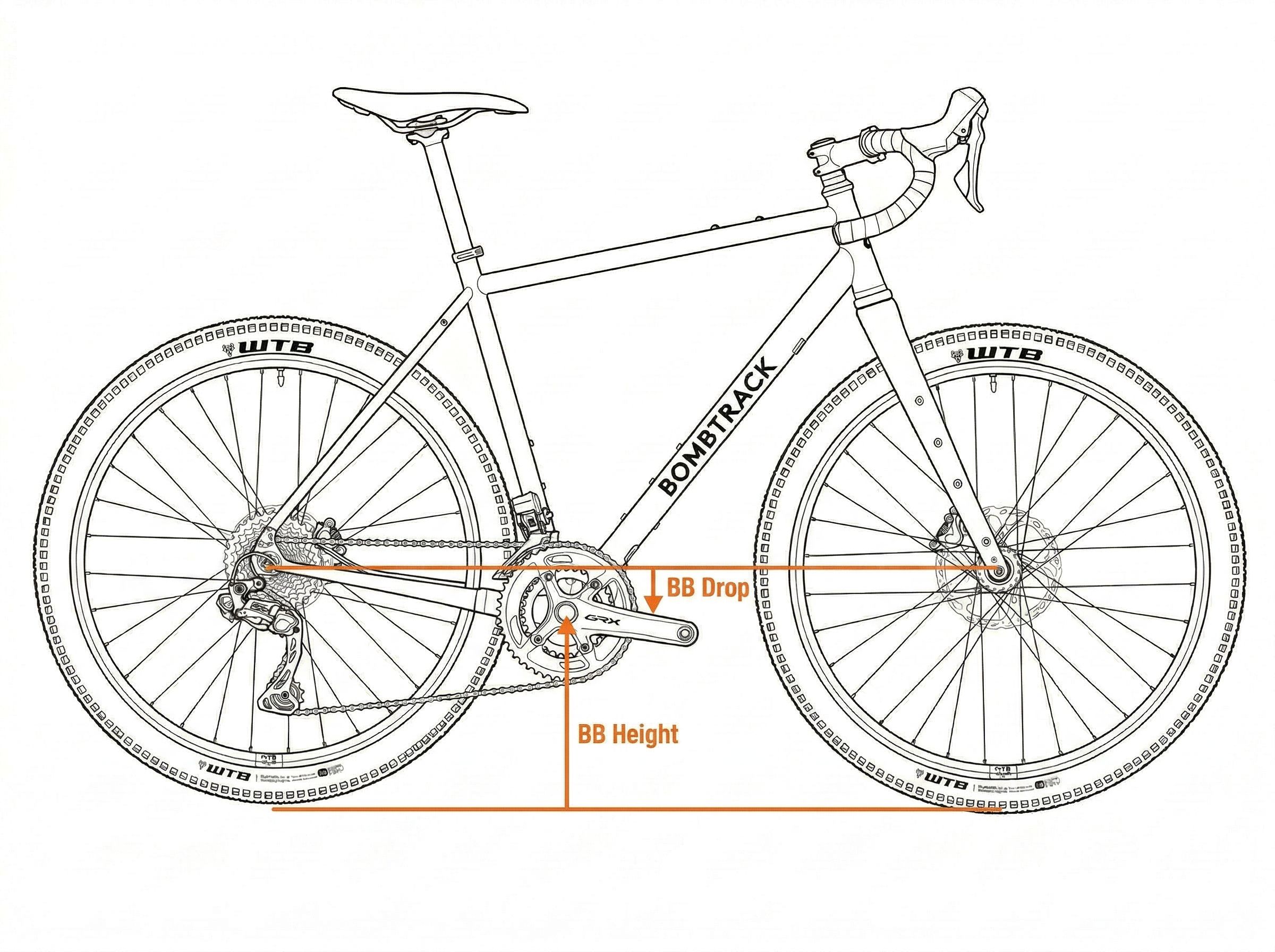
BB Drop indicates how much lower the bottom bracket is compared to the line connecting the wheel axles.
It defines how much the rider’s centre of mass sits “inside” the bike.
A larger BB Drop tends to:
- increase stability
- make the bike feel more “planted”
- improve confidence in faster corners
Indicative References (medium size, 700C wheels)
| BB Drop | Indicative value | Ride feel |
|---|---|---|
| low | ~55–60 mm | taller, more agile bike |
| medium | ~60–70 mm | balance between stability and clearance |
| high | ~70–80 mm | lower centre of gravity and very stable ride |
Note: indicative values referring to medium-size frames. They may vary depending on frame size, wheel diameter and intended use.
Warning on Technical Terrain
A high BB Drop is excellent for stability, but on rough terrain it can increase the risk of pedal strike (pedals hitting the ground).
For this reason, in more aggressive off-road setups some riders choose slightly shorter cranks.
| Crank length | Typical use |
|---|---|
| 175 mm | traditional road use |
| 170–172.5 mm | gravel / adventure |
| 165–170 mm | technical off-road |
Reducing crank length slightly increases pedal ground clearance, reducing the probability of impacts.
The Real Role of Trail
The most important parameter for understanding steering stability is trail.
Trail depends on:
- head angle
- fork offset
- wheel diameter
This is why two bikes with the same head angle can behave very differently.
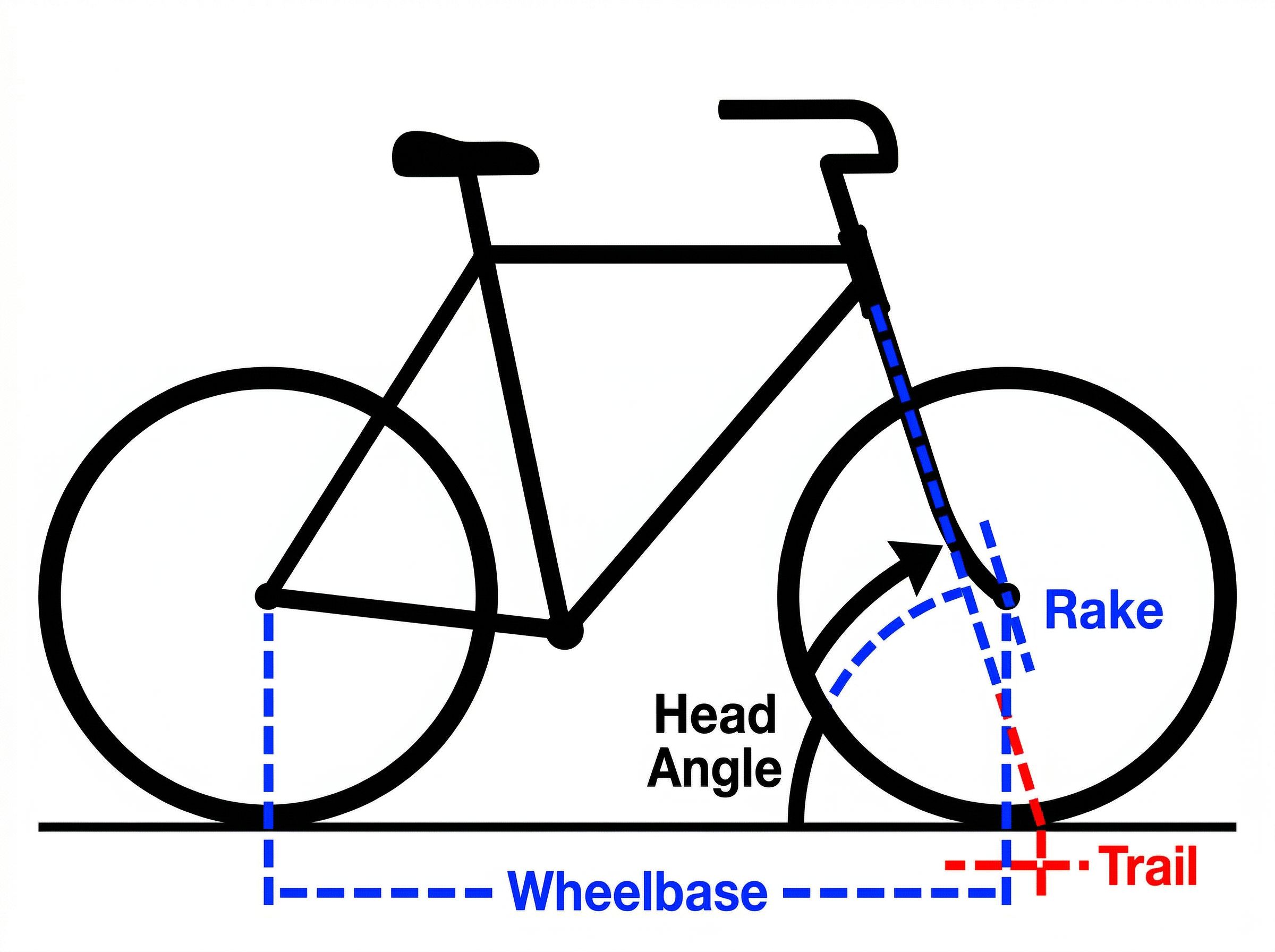
Trail is a dynamic value: as shown in the diagram, it is determined by the head tube angle, fork offset, and actual wheel diameter.
In general:
- High trail → greater stability and self-centring
- Medium trail → balance between stability and agility
- Low trail → fast, reactive steering
If you want to calculate the trail of your current setup, you can use technical tools such as the calculator on yojimg.net.
Geometry and Categories: What Really Changes
Broadly speaking:
- Gravel / Allroad prioritise balance, smoothness and responsiveness on mixed surfaces
- Modern Adventure / Touring focus on stability, control and coherent behaviour under load
- Classic cycle touring emphasises long-term stability and comfort
These are not rigid categories: they are design shades of the same travel-bike concept.
Quick Decision Framework
| Primary use | Typical geometry | Real-world behaviour |
|---|---|---|
| Gravel / Allroad | medium wheelbase, moderate trail | responsive and smooth ride |
| Modern Adventure / Touring | longer wheelbase, more stable trail | control on rough terrain and under load |
| Classic cycle touring | very relaxed geometries | maximum stability and comfort over long distances |
In Summary
Geometry is not a list of isolated numbers.
Real-world handling depends on the interaction between:
- trail
- wheelbase
- head angle
- chainstay length
- bottom bracket height
together with:
- tyre size and pressure
- load distribution
- rider position
An effective bike is not the one with the most extreme numbers, but the one that remains coherent as surfaces worsen and stress repeats day after day.
Not sure which geometry fits your next trip? Contact us for a personalised technical recommendation.
FAQ – Geometry and Touring Bikes
What is the most important geometry parameter?
Trail is one of the best indicators of steering stability because it summarises the effect of head angle, fork offset and wheel diameter.
Is a slacker head angle always more stable?
Not necessarily. Stability depends on the interaction between trail, wheelbase and weight distribution.
Can a gravel bike be used for touring?
Yes, especially for light travel or smoother surfaces. With continuous load, a touring-oriented geometry often becomes more comfortable.
Does a longer wheelbase make the bike slower?
Not slower in absolute terms: it makes the bike less reactive but often more stable and less fatiguing over long distances.
Is a lower bottom bracket always better?
It improves stability but can increase the risk of pedal strikes on technical terrain.
Do tyres influence geometry?
They do not change the frame’s geometry, but they strongly affect how the bike behaves.
What is the real difference between gravel and adventure?
Gravel prioritises speed and smoothness on mixed surfaces, while adventure bikes focus more on stability and control on rougher terrain.
Does load change how the bike handles?
Yes. Adding weight amplifies the geometry’s characteristics and can make some bikes more stable and others more nervous.