
- Width, Pressure and Suspension in Touring: What Really Matters
- The Tyre Is the First Suspension
- Tyre Width: How Wide Is “Enough”?
- Pressure: The Most Underrated Parameter
- Comfort Does Not Mean Softness
- When a Suspension Fork Truly Makes Sense
- Common Mistakes in the Search for Comfort
- Platforms That Work with Real Comfort
- In Summary
- FAQ – Tyres and Comfort in Touring
Width, Pressure and Suspension in Touring: What Really Matters
In bicycle travel, comfort is not an accessory concept.
It is a technical variable that directly affects control, fatigue, safety and riding continuity.
Comfort is often associated with complex or expensive solutions: “compliant” frames, suspension forks, specific components. In reality, in most real-world journeys, the first and most effective form of suspension is far simpler: the tyre.
Understanding how width, pressure and tyre type interact with the route is essential to building a touring bike that truly works — without unnecessary complications. For a broader view on how real-world terrain shapes every technical decision, see Touring bike – Complete guide to choosing the right one.
The Tyre Is the First Suspension
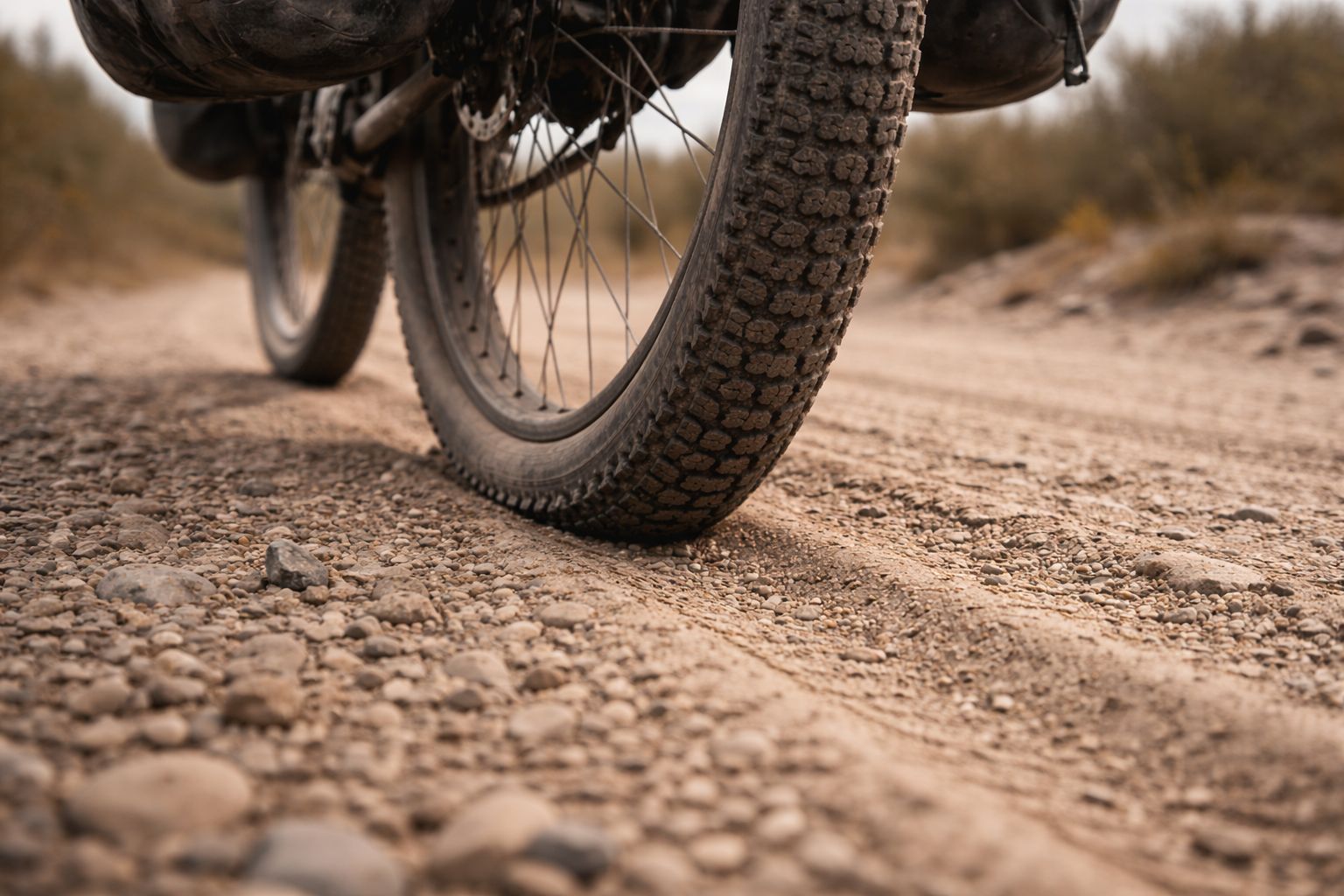
Any touring bike, regardless of frame material, works through the contact between tyre and ground.
This is where vibrations, micro-impacts and irregularities are absorbed — irregularities that, over many consecutive hours, become accumulated fatigue.
A tyre with adequate volume and correct pressure:
-
continuously filters rough surfaces
-
improves traction on irregular terrain
-
reduces the need for micro-corrections while riding
-
protects wheels and frame from unnecessary stress
In real-world travel — especially on imperfect surfaces — a well-chosen tyre contributes more to comfort than many other upgrades combined.
Tyre Width: How Wide Is “Enough”?
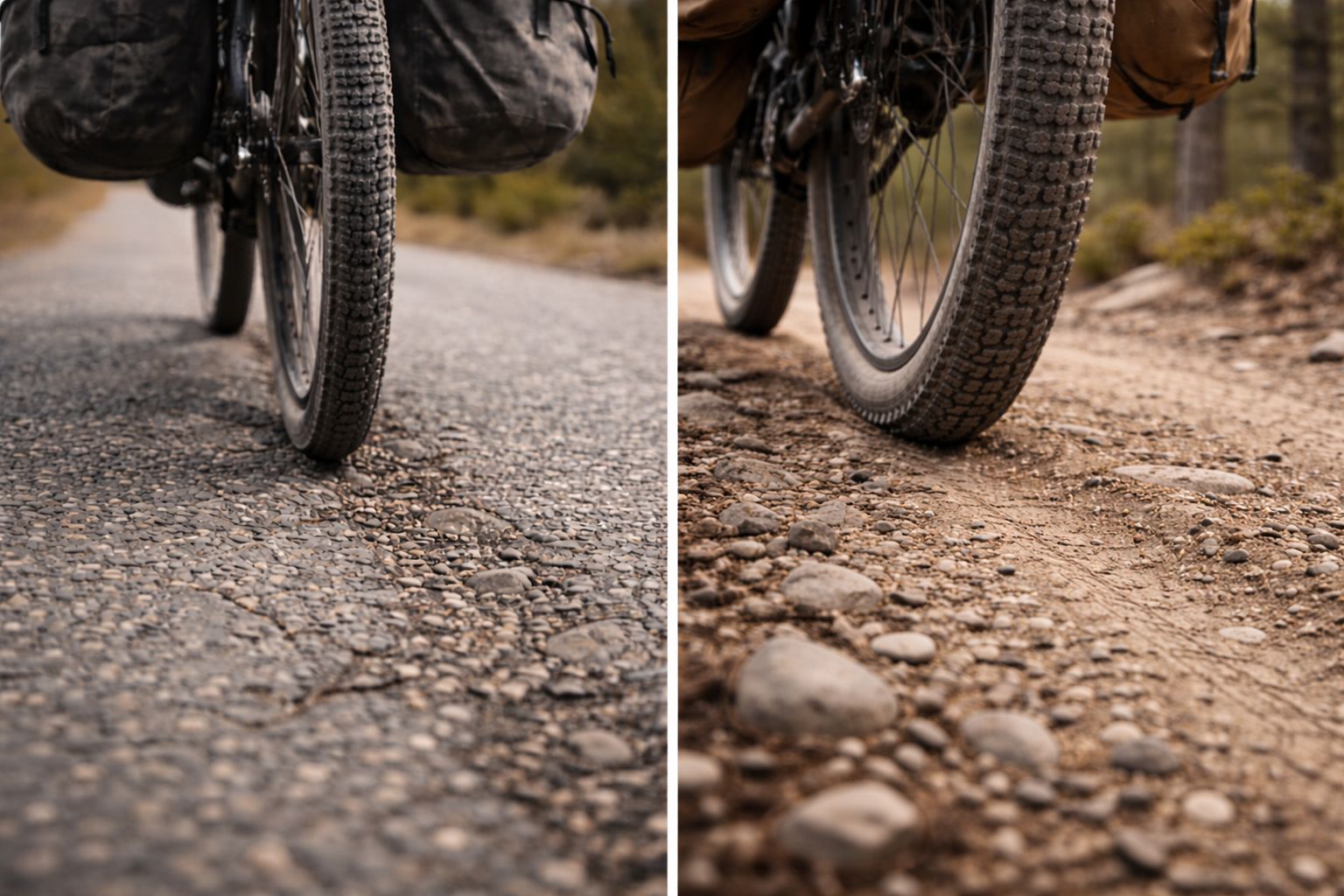
In recent years, touring tyre widths have increased significantly. That does not mean “wider is always better.”
There is a sufficient width, beyond which benefits diminish or change in nature.
These are realistic reference ranges — not rigid rules:
32–38 mm
Suitable for predominantly asphalt touring and well-maintained secondary roads. Offers noticeably more comfort than traditional road sections without compromising rolling efficiency and continuity.
40–45 mm
The balance zone for mixed travel and advanced bikepacking. Handles irregular asphalt, compact gravel and deteriorated sections with good control while maintaining ride coherence.
47–55 mm
Makes sense when gravel is frequent or continuous, or when surfaces remain rough for long stretches. Here, volume actively works as passive suspension.
Over 55 mm
Appropriate in specific adventure contexts: remote tracks, sand, coarse gravel or heavily degraded terrain. This is not a universal choice, but a targeted one.
Practical example:
A touring bike ridden on irregular asphalt with constant rear load is often more comfortable and stable on a properly inflated 38–40 mm tyre than on a 50 mm tyre at incorrect pressure. Comfort comes from balance, not absolute volume.
Pressure: The Most Underrated Parameter
Tyre pressure is often what compromises comfort, even on technically sound bikes.
Too high, and the bike becomes harsh, nervous and fatiguing.
Too low, and you lose efficiency and stability under load.
In touring, pressure is not fixed:
-
it depends on total weight (rider + luggage) and how that load is positioned on the bike, as explained in Load distribution — Guide.
-
it varies with terrain
-
it differs between front and rear (when part of the load is placed on the fork, riding dynamics change significantly, as described in Front load — Guide)
Practical guideline:
The correct pressure allows the tyre to visibly deform under load without collapsing. If you feel continuous vibration on rough surfaces, pressure is probably too high. If the bike feels vague or unstable, it is too low.
Reducing pressure by just 0.2–0.3 bar can radically improve comfort and control.
Comfort Does Not Mean Softness
A comfortable bike is not a “soft” bike.
It is a readable one — predictable, stable, not requiring constant correction and not transmitting unnecessary stress to the body.
Oversized or overly soft tyres, especially on frames not designed for them, can:
-
reduce steering precision
-
increase long-term fatigue
-
make the bike unstable under load
Functional comfort comes from coherence between:
-
tyre width
-
pressure
-
frame geometry
-
load type
When a Suspension Fork Truly Makes Sense
A suspension fork is not a universal solution for touring.
It makes sense only when rough terrain is continuous, predominant and structural.
It is useful when:
-
surfaces consist of damaged tracks or continuous trail
-
vertical impacts are constant for many hours
-
average speed is low and control is the priority
It becomes unnecessary or even counterproductive:
-
in asphalt touring
-
in mixed travel with regular gravel
-
when tyre volume already provides sufficient filtration
Brands such as Bombtrack, Salsa and Surly design platforms intended to work with generous tyre clearance before resorting to suspension — precisely because, in most real journeys, this approach is simpler and more reliable.
Common Mistakes in the Search for Comfort
One frequent mistake is stacking solutions without coherent logic:
-
very wide tyres on frames not designed for them
-
suspension forks on bikes intended for front-load racks
-
road-level pressures on touring tyres
Another mistake is chasing catalogue comfort instead of real comfort — the kind that reveals itself only after many consecutive hours of riding.
Platforms That Work with Real Comfort
Frames designed with balanced geometries and adequate tyre clearance allow comfort to be adjusted without forcing the project. This is true of many Ritchey platforms, as well as numerous adventure and travel models from Bombtrack, Salsa and Surly, where tyre choice is integral to the design — not an afterthought.
In Summary
In real-world touring:
-
the tyre is the first suspension
-
pressure is the true adjustment tool
-
a suspension fork is a niche choice, not a necessity
-
comfort comes from coherence, not from stacking solutions
A comfortable touring bike is one that continues to function when surfaces deteriorate and hours accumulate — without asking the rider’s body to compensate for design inconsistencies.
FAQ – Tyres and Comfort in Touring
Which tyres are best for a touring bike?
Those coherent with the route: narrower for continuous asphalt, wider for mixed or rough terrain. There is no universal size.
Do wider tyres make the bike slower?
Not necessarily. At correct pressure, a wider tyre can be more efficient on irregular surfaces than a narrow, overinflated one.
Is a suspension fork necessary for touring?
Only if the terrain is predominantly rough and continuous. In many journeys, the tyre already does the necessary work.
How important is pressure for comfort?
Extremely. It is often the most underestimated factor and offers the greatest immediate improvement.
Are comfort and control the same thing?
In touring, yes. A comfortable bike is one that remains predictable and stable when conditions become demanding.