
Beyond the snow: new possibilities for exploration
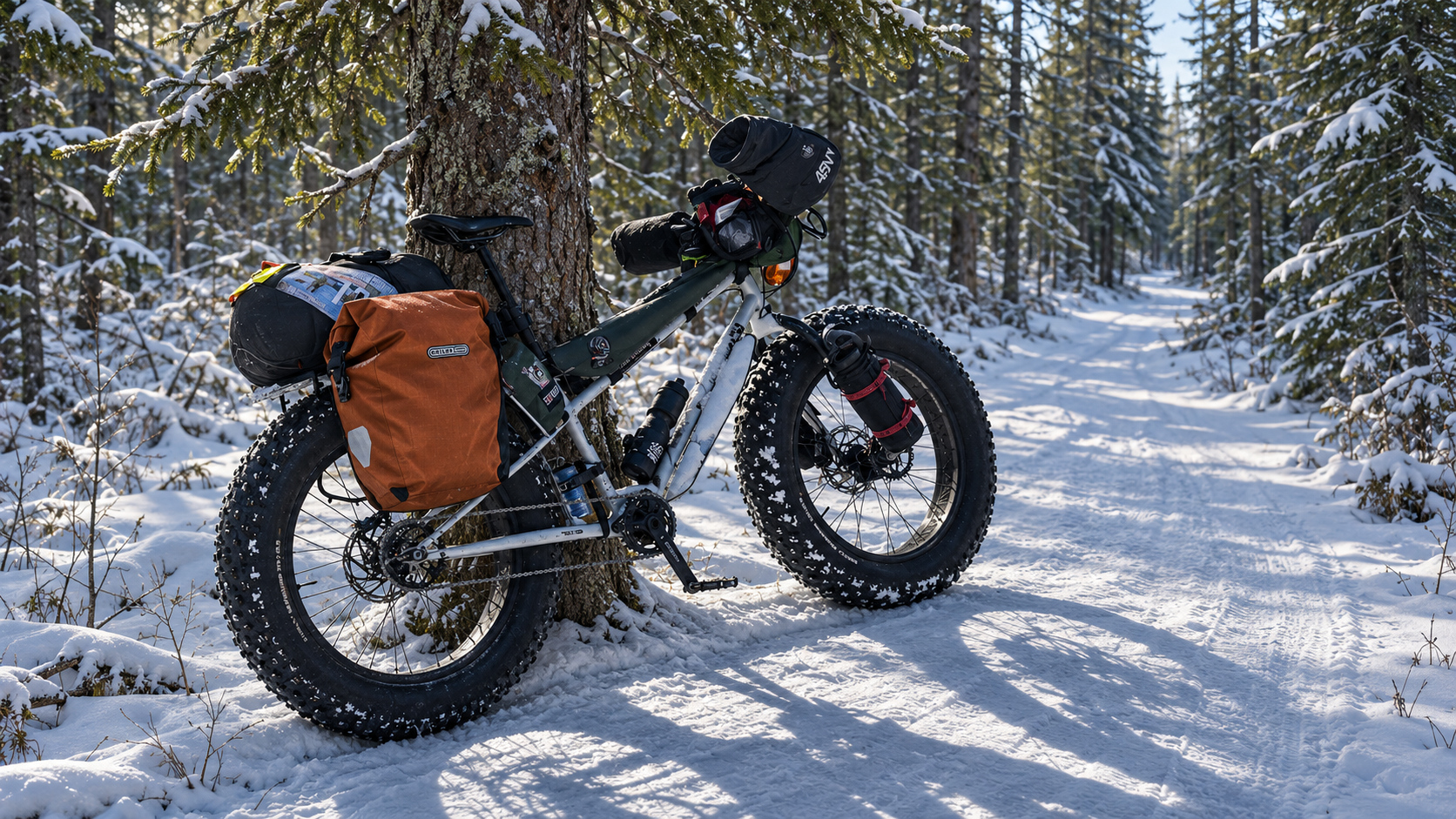
There are places where travelling by bike takes on a different character. A forest track disappears beneath the snow, a trail gives way to sand, or a volcanic landscape alternates between firm ground and sections where the wheels seem determined to sink. You need not travel far to experience this: a heavy snowfall can turn familiar routes into a completely different environment.
Fat bikes were developed to extend the possibilities for exploration on precisely this sort of terrain. Their high-volume tyres help spread the load, find traction and keep moving across surfaces that would quickly defeat many conventional bicycles.
But describing a fat bike simply as a bicycle for snow misses much of the picture. It can be a travelling companion, a particularly enjoyable mountain bike on trails, a bikepacking platform or a specialist exploration machine. And it can remain useful long after the snow has melted and the ground is dry again.
Not every fat bike approaches these possibilities in the same way.
The SURLY Wednesday strikes a balance between touring, trail riding and versatility. The SURLY Ice Cream Truck combines larger-volume tyres with geometry aimed at technical trail riding. The SURLY Moonlander takes flotation into more specialised territory, with 6.2-inch tyres and an integrated Pinion gearbox.
Choosing between them involves more than comparing tyre widths. You need to understand how the tyres interact with the ground, how luggage changes the bike's behaviour and which design features suit the way you want to ride.
That is where this guide begins: with the experiences these bikes make possible, through the technical considerations, and ultimately to choosing the right bicycle.
Three fat bikes, three approaches to exploration
The Bikejamming selection brings together three SURLY platforms with distinct characteristics, although their potential uses overlap.
| Model | Standard specification | Character | Uses |
|---|---|---|---|
| SURLY Wednesday | 26×3.8″, Shimano CUES 1×11 | Versatile adventure bike | Touring, snow, sand, trails, bikepacking |
| SURLY Ice Cream Truck | 26×4.8″, Shimano Deore 1×12 | Trail-focused fat bike | Technical trails, soft ground, exploration |
| SURLY Moonlander | 24×6.2″, Pinion C1.9 XR | Specialist exploration bike | Deep snow, soft sand, exceptionally yielding terrain |
Explore the bikes in the Bikejamming range:
- SURLY Wednesday CUES 1×11 — Adventure Fat Bike
- SURLY Ice Cream Truck Deore 1×12 — Trail Fat Bike
- SURLY Moonlander Pinion — Expedition Fat Bike
This is not a ranking from the least capable bike to the most capable. It is a selection of different designs.
Wednesday is not simply a Moonlander with narrower tyres. Ice Cream Truck is not merely a Wednesday with wider ones. And Moonlander is not necessarily the best choice for every snowy route.
The differences become clearer when you consider how each bicycle deals with the terrain and the riding experience it prioritises.
Why a fat bike can ride where other bicycles sink
Flotation is about more than tyre width
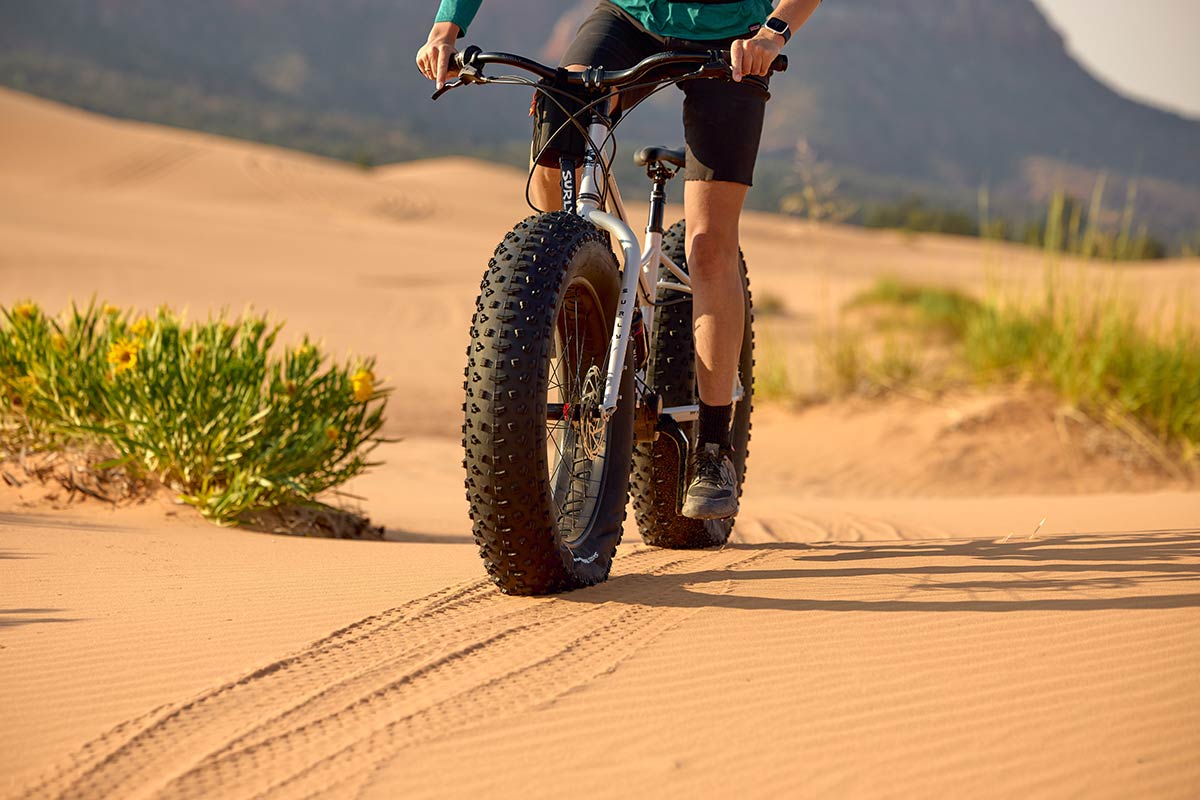
On firm roads, the ground supports the bicycle's weight without deforming significantly. On soft snow or dry sand, however, some of your pedalling energy goes into displacing material and climbing out of the rut left by the wheel.
As a tyre sinks, forward progress becomes harder. Resistance increases, steering can become less precise and maintaining a steady cadence becomes difficult.
The high volume of fat-bike tyres allows relatively low pressures, spreading the load across a contact patch better suited to yielding ground.
But nominal tyre width does not automatically determine actual flotation.
Several factors influence how a tyre behaves:
- Inflation pressure, which affects how the tyre deforms.
- Casing construction and its ability to conform to the surface.
- Rim width, which changes the tyre's profile and lateral support.
- Tread pattern, which affects traction, braking and cornering.
- The combined weight of rider, bicycle and luggage.
- Ground conditions, which can change within just a few metres.
At the same load and pressure, a wider tyre does not necessarily create a larger contact patch; it may primarily change its shape. One advantage of greater volume is the ability to reduce pressure further while retaining usable support.
This helps explain why two fat bikes with apparently similar tyres can behave quite differently.
Tyre pressure is a setting to adjust, not a fixed number
On a fat bike, small changes in pressure can make a noticeable difference to wheel behaviour.
On soft ground, excessive pressure can prevent the tyre from conforming to the surface. The wheel may dig in, bounce over irregularities or lose traction.
Reducing pressure gradually allows the tyre to deform more, find support and absorb some of the bumps.
Go too low, however, and other problems appear: less precise steering, excessive casing deformation in corners, greater exposure of the rim to impacts and possible sealing or pinch-flat problems, depending on the system.
There is no single ideal pressure for every fat bike.
The 45NRTH guide Rules of Fat: Dialing in Tire Pressure explains why pressure needs to be adapted to the rider, tyres and snow conditions.
A practical approach is to start at a pressure suitable for the wheel-and-tyre system, ride a short representative section and make small adjustments while observing how the bicycle responds.
If the wheel sinks and loses momentum, it may help to seek a larger, more supportive contact patch. If the casing deforms excessively and steering becomes vague, the tyre needs more support.
Front and rear pressures may differ: weight is not distributed equally between the wheels, especially with luggage.
An accurate low-pressure gauge is therefore particularly useful. And when moving from a long soft section onto firm ground, it can make sense to reassess tyre pressure.
This is not a complication reserved for experts. It is one of the adjustments that lets you appreciate what a fat bike can really do.
Casing and tread: two tyres of the same size are not equivalent
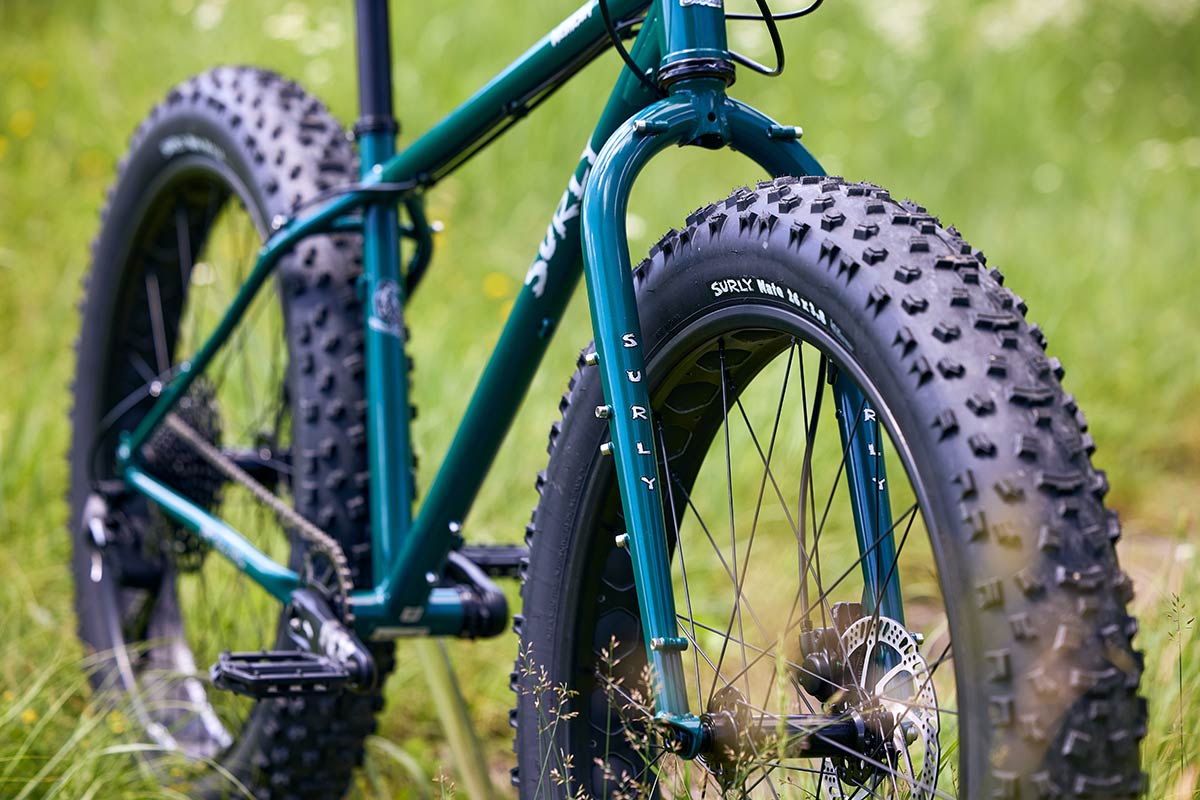
The size printed on the sidewall tells only part of the story.
A supple casing can conform to irregularities more readily, while a more supportive construction may offer different protection and stability characteristics. Knob layout also matters: the ability to transmit pedalling force is not necessarily the same as the ability to brake or maintain grip through corners.
On snow, for example, the tread may need to work on a surface that is packed, granular, wet or very soft.
On sand, the main challenge may be reducing sinkage without losing directional control.
On rocks and roots, casing deformation, lateral support and control become more important.
Tyre choice is therefore part of the bicycle's overall design, not a minor detail of its specification.
Fat biking on snow: from groomed trails to winter exploration
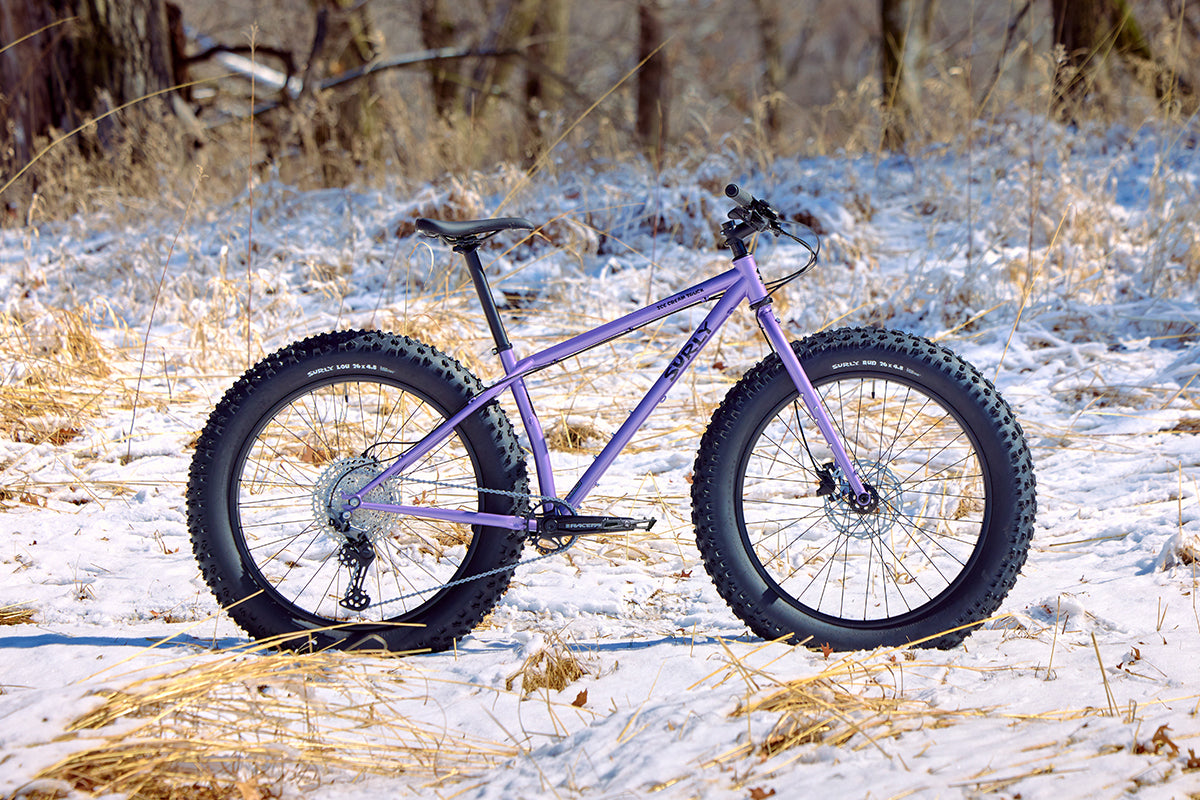
Riding on snow is probably the first image most people associate with fat bikes. But snow comes in many forms, and there is more than one way to use these bicycles in winter.
Finnish Lapland: riding maintained winter trails
Around Ylläs in Finland, winter cycling takes place partly on a network of maintained routes shared by walkers and cyclists.
Trail maintenance and snow consolidation make it possible to ride in an environment that could be far more demanding without a prepared surface.
It is a useful reminder that a snowy fat-bike trip does not have to be an extreme expedition.
You can plan day rides, explore snow-covered forests and follow dedicated winter routes, adjusting distance and difficulty to your experience.
On a sufficiently firm trail, a conventional fat bike such as Wednesday can be a sensible choice. It combines high-volume tyres, a mountain-bike riding position and a platform that remains useful for many other activities throughout the year.
Ice Cream Truck can be equally appealing, particularly if you want more tyre volume and a stronger emphasis on trail handling.
Moonlander occupies a different space: its extreme tyre volume becomes especially relevant when the snow is soft enough to challenge even a conventional fat bike.
You do not have to seek out the deepest possible snow to enjoy the experience. Often the pleasure is simply riding through a quiet forest on a surface that completely changes the character of familiar trails.
For planning a ride around Ylläs, local information on maintained winter trails and their condition is available. Dedicated cycling routes must be distinguished from ski-only tracks.
Fresh snow, transformed snow and ice
After heavy snowfall, the same trail can become softer. Support decreases and the wheels tend to sink further.
In these conditions, tyre pressure and volume become more important.
This is where the distinction between a versatile fat bike and a platform designed to maximise flotation becomes apparent.
When snow turns to ice, the problem changes again. It is no longer simply about spreading weight, but about finding grip on a hard, slippery surface.
Studded tyres can provide a specific advantage on ice. Their usefulness depends on the surface and the bike's compatibility: a very wide tyre is not automatically a substitute for a studded one.
Soft snow, groomed trails and ice therefore call for different adjustments and sometimes different tyres. Understanding these distinctions makes it possible to use the same fat bike across a wider range of conditions.
Fat biking on sand: when the ground shifts beneath your wheels
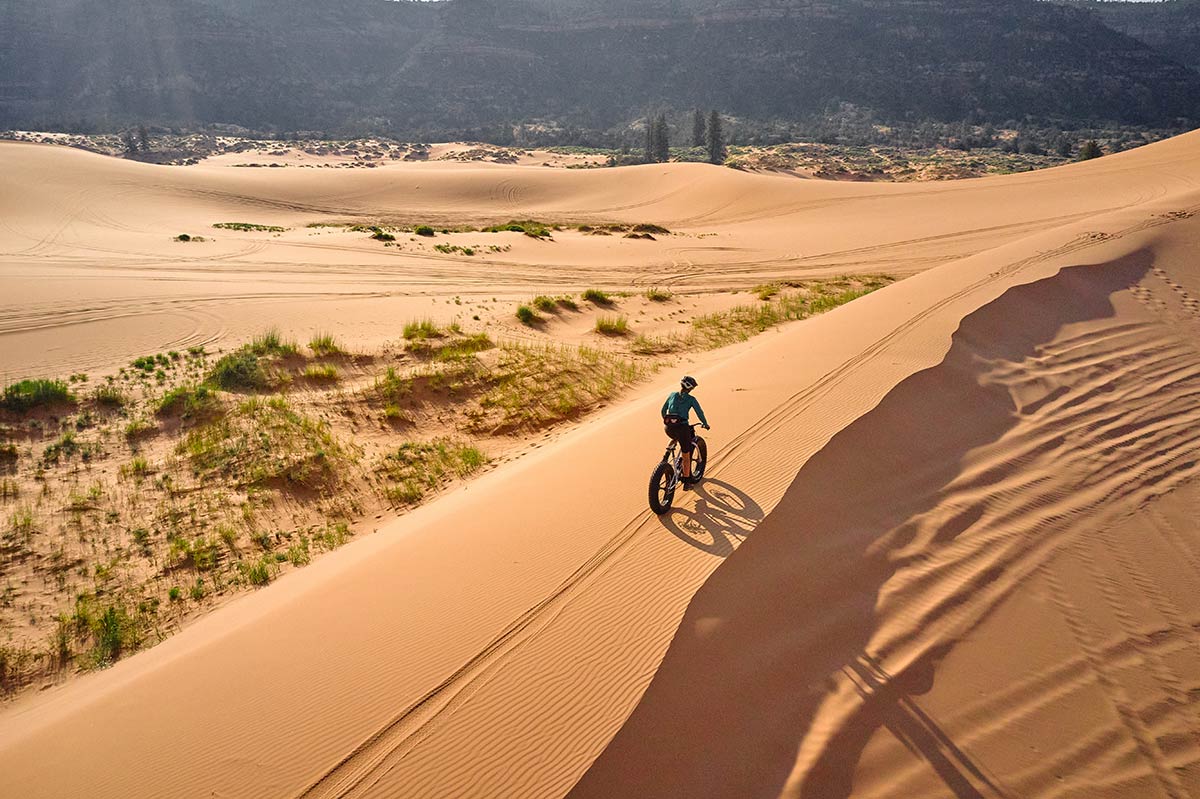
Sand is another environment where a fat bike can fundamentally change the riding experience.
Firm sand near the waterline may roll relatively easily. Just a few metres inland, dry sand can become deep and absorb much of your pedalling energy.
The same happens on desert tracks, dunes, sandy riverbeds and some volcanic terrain.
Here a fat bike is not simply about added comfort. It can make the difference between continuing to ride and having to push for long stretches.
How much continuous sand is there?
A short sandy crossing does not necessarily determine the bicycle you should choose for an entire trip.
But if sand continues for kilometres, the calculation changes. Every metre you can ride without sinking means less energy spent, fewer interruptions and better progress.
The Secret Mesa Loop in Utah, documented by BIKEPACKING.com, is a useful example. It includes a long sandy stretch along Coal Wash. The authors used fat tyres and also mention a plus-tyre setup of at least 3 inches as a possibility, albeit potentially more difficult.
You do not need to recreate that route to understand the principle.
A fat bike can also be worthwhile for coastal exploration, sandy tracks and mixed routes where soft sections occur frequently enough to affect the whole day.
Choosing between Wednesday, Ice Cream Truck and Moonlander then depends on sand depth, luggage weight and how much of the route genuinely calls for greater flotation.
Beaches, coastlines and Mediterranean environments
European coastal landscapes offer very different conditions.
A gravel track crossing a dune area does not necessarily require a fat bike. A long, rideable sandy surface, on the other hand, can make one particularly appealing.
In the Camargue, for example, the Digue à la Mer crosses a striking coastal landscape, but the documented cycling route runs predominantly over unpaved tracks. It would be misleading to describe it as a route across dunes or deep sand.
It is a useful reminder: being close to the sea does not tell you what surface you will be riding on.
To find a genuinely sandy riding experience, you need to identify sections where cycling is permitted, distinguishing between beaches, tracks, protected dunes and restricted areas.
The pleasure of a fat bike lies in exploring unusual surfaces where access is allowed, without turning every outing into an expedition.
When sand becomes a journey
A particularly interesting account is Mattia Dalvit's, published by Bikepacking Baja in 2025.
Dalvit rode a SURLY Ice Cream Truck in Baja California, including sandy environments, and later experimented with a 29×3″ wheel setup.
The conversion noticeably changed the bike's behaviour: it was more advantageous on certain trails and climbs, but less capable in deep sand than the original fat-tyre setup.
The value of the experience is not that one solution is always better than the other.
It illustrates something more useful: the same platform can take on a different character when the wheel-and-tyre system changes.
Dalvit also expressed reservations about Ice Cream Truck for his particular remote-travel needs, especially the vulnerability of the rear derailleur and integrated hanger. These observations are worth understanding in context, rather than treating them as reasons to dismiss the bike's abilities on the terrain it was designed for.
On the trail: a fat bike can be much more than a snow bike
Fat-tyre volume is useful for more than soft ground.
On rough trails, roots, rocks and uneven sections, a very high-volume tyre can conform to the surface and help maintain traction and control.
The result is not the same as a mountain bike with suspension. A tyre absorbs impacts through deformation, but it does not provide the hydraulic damping of a suspension fork.
Even so, the riding experience can be remarkably engaging. The bike rolls over obstacles, finds support and lets you explore different lines, with a distinctive feel.
This is where Ice Cream Truck's character comes to the fore.
Geometry and handling: fat bikes do not all respond alike
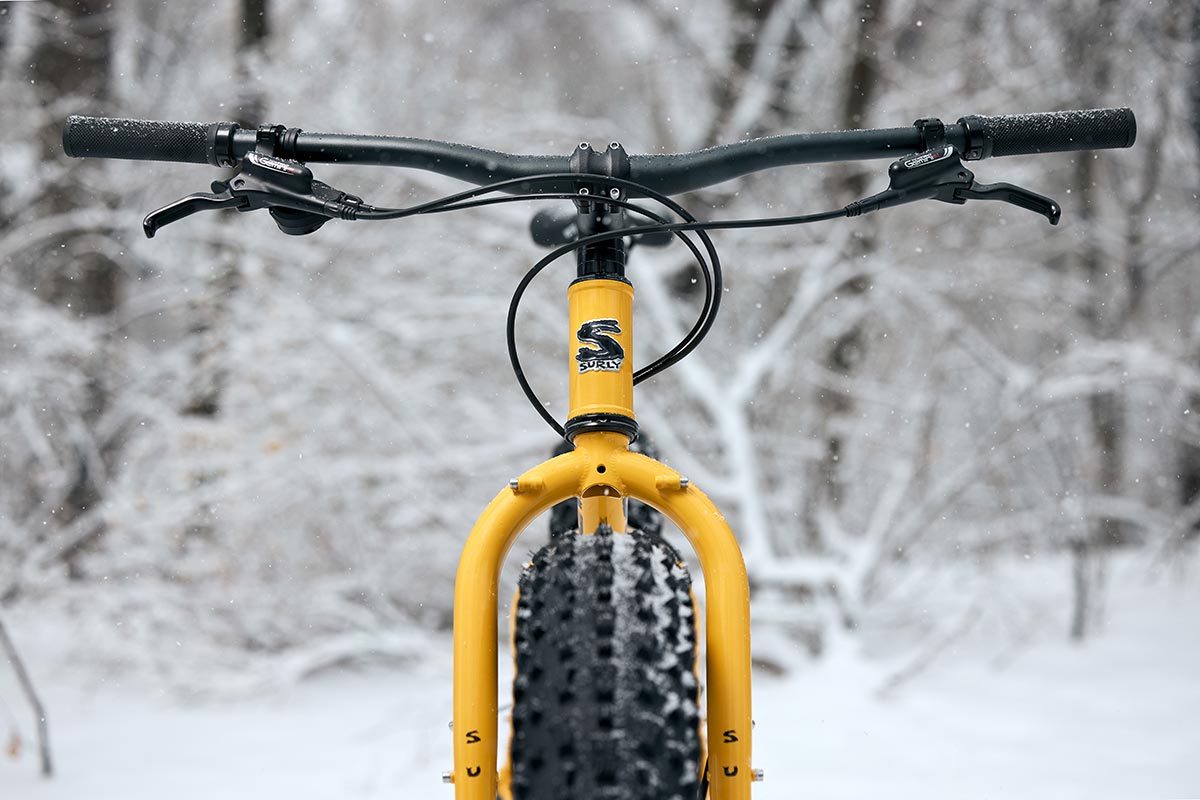
Ice Cream Truck is designed around trail-oriented geometry, with a 68° head angle and 440 mm chainstays.
Wednesday uses a different configuration, with a 69° head angle and adjustable rear dropouts; its chainstay length is 435 mm in the reference position used for SURLY's official geometry.
These differences help explain the design intent, although the actual riding feel also depends on size, rider position, tyres and setup.
Moonlander stands much further apart, with chainstays of approximately 562 mm. Its extended rear end contributes to stability and accommodates enormous tyres, but demands a different approach in tight passages and quick manoeuvres.
These geometries do not establish which bicycle is universally the most fun.
They show why the enjoyment of riding a fat bike can take very different forms: Wednesday's versatility, Ice Cream Truck's trail character and Moonlander's distinctive ability to keep moving over difficult ground.
Fat bikes and bikepacking: when travel adds weight
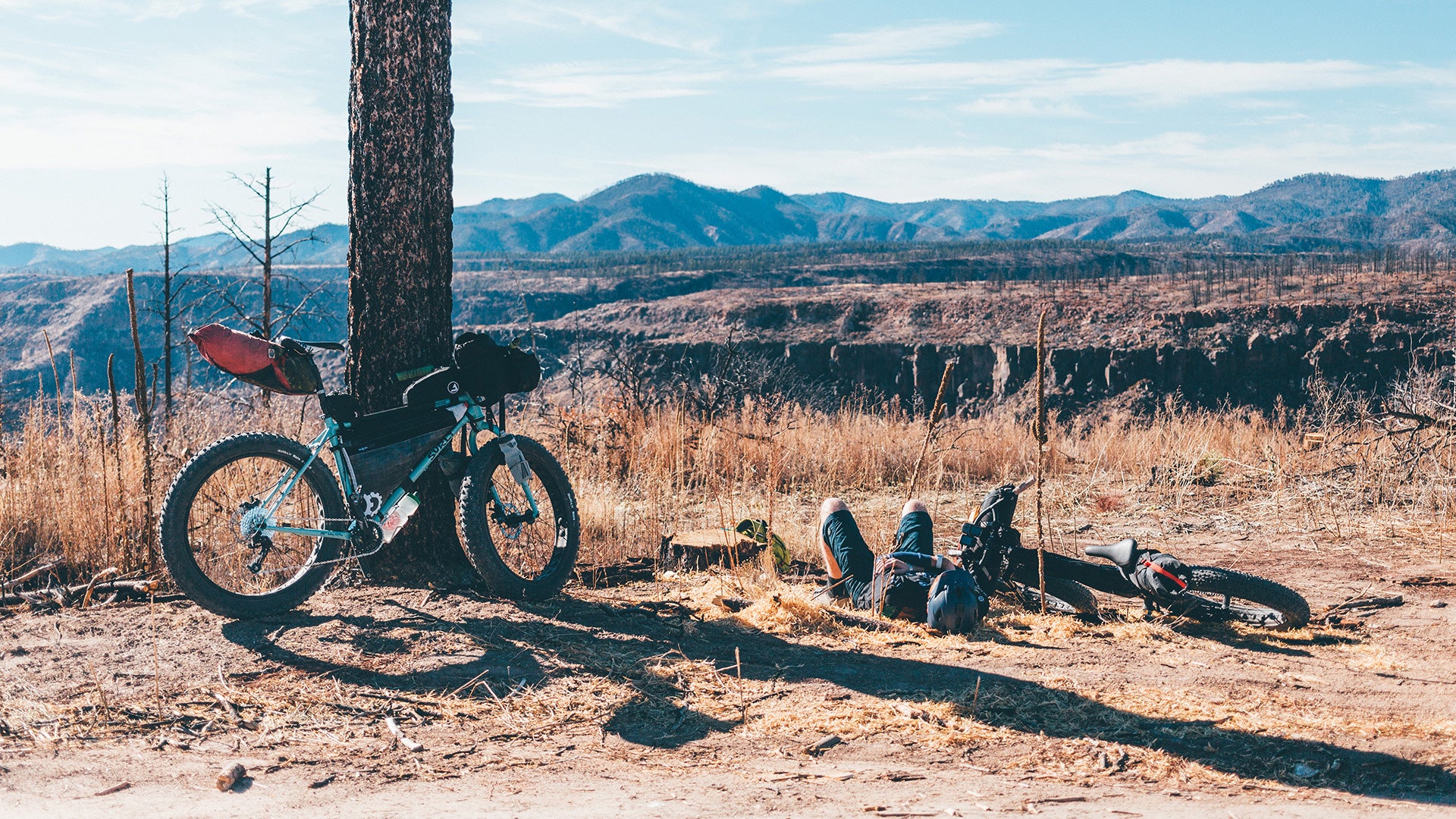
An unloaded fat bike and the same bicycle equipped for several days of travel do not behave in quite the same way.
Water, food, shelter, clothing and equipment change the weight carried by the wheels. They also affect load distribution, steering response and traction.
On firm ground, these differences can be relatively easy to manage. On sand or soft snow they become more apparent, because the surface itself helps determine how much weight each wheel can support before sinking.
Distribute the load, don't just carry it
A good bikepacking setup is not simply a matter of filling every available bag.
Weight needs to be distributed so that steering accuracy, control and freedom of movement are maintained.
Rear luggage changes how the rear tyre works; front luggage affects steering and obstacle response. A frame bag can concentrate some weight relatively centrally, although available space varies by model and frame size.
The three SURLY bikes offer different options for fitting bags, racks and accessories.
Wednesday combines touring mounts with a versatile platform.
Ice Cream Truck retains a trail-oriented layout while offering useful luggage mounts.
Moonlander has a very long rear end and distinctive geometry which, in Neil Beltchenko's test, also performed convincingly with luggage.
There is no perfect load distribution for everyone: it depends on equipment, weight, frame size and route. A well-considered setup can nevertheless make the bicycle more enjoyable and predictable over many kilometres.
Low gears and a consistent cadence
On snow and sand, the challenge is not always a steep climb.
Even a seemingly flat section can demand considerable effort when the ground resists forward motion.
That is why sufficiently low gearing matters.
The current Wednesday uses Shimano CUES 1×11, with a 30-tooth chainring and an 11–50T cassette.
Ice Cream Truck has Shimano Deore 1×12, with a 30-tooth chainring and a 10–51T cassette.
Moonlander instead uses a nine-speed integrated Pinion C1.9 XR gearbox.
The number of gears alone is not enough to compare these drivetrains. You also need to consider gear development, effective wheel diameter and the demands of the terrain.
On yielding surfaces, maintaining a steady cadence is particularly helpful, avoiding sudden accelerations that can break traction.
Pinion gearbox and spare parts: two sides of self-sufficiency
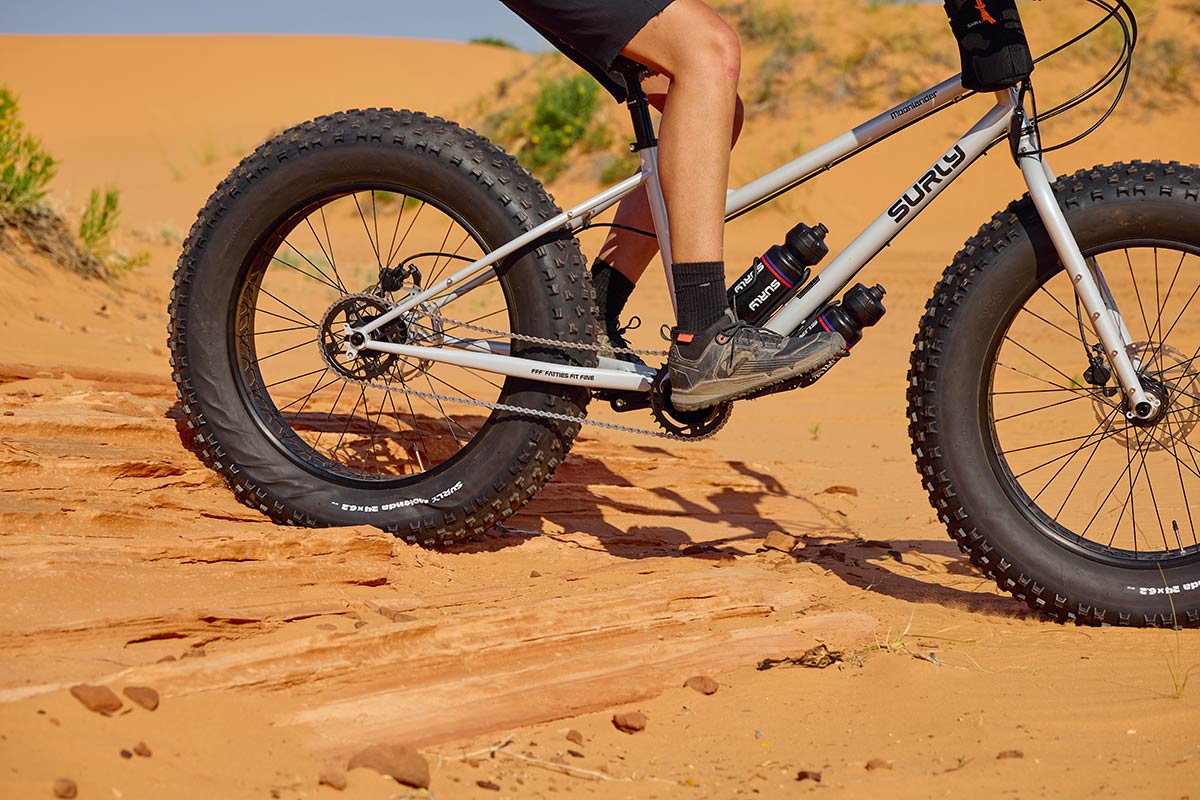
Moonlander's Pinion gearbox introduces a significant difference from conventional rear-derailleur drivetrains.
The gears are enclosed in a central unit, protected from the direct exposure of a rear derailleur. This can be attractive on difficult ground, through sand and mud, and on journeys far from mechanical assistance.
It does not, of course, mean the bicycle is maintenance-free or immune to problems.
Self-sufficiency also depends on being able to deal with tyres, inner tubes, the chain, brakes and specialist components.
On a remote expedition, a very practical question is: if I damage a tyre, can I repair or replace it?
On Moonlander, the Molenda 24×6.2″ tyres are highly specialised. You cannot assume a replacement will be available along the route.
It therefore makes sense to prepare a repair kit suited to the wheel system and the duration of the journey.
The same principle applies to Wednesday and Ice Cream Truck, even though they use less unusual fat-tyre sizes.
Another important point is SURLY's stated limit for Moonlander: 110 kg combined rider and luggage weight, related to the Pinion system's limitations. This is not the luggage allowance alone. It deserves particular attention when planning a heavily equipped trip.
None of these considerations should discourage exploration. They are part of the preparation that makes it possible to travel with greater confidence.
From Lapland to Iceland: three ways to use a fat bike
Real routes help illustrate just how much the role of a fat bike can change.
Ylläs: discovering winter cycling
Maintained trails in Finnish Lapland provide an environment where riding on snow can be accessible without organising a self-supported expedition.
Here Wednesday and Ice Cream Truck offer two interesting approaches, especially when the surface is consolidated and the route includes forest tracks and winter trails.
The widest tyre is not automatically the right choice. The desired riding style, equipment and intended use throughout the rest of the year also matter.
Iceland: crossing volcanic landscapes with luggage
The Iceland Divide, documented by Montanus on BIKEPACKING.com, crosses part of the Icelandic Highlands over approximately 554 kilometres, mainly on tracks and unpaved roads.
Volcanic sand, isolation, uneven ground and the need to carry equipment make this a particularly interesting bikepacking environment.
A fat bike may offer advantages here not only through flotation, but also through traction and the ability to deal with changing surfaces.
Wednesday could suit riders prioritising versatility across different terrain. Ice Cream Truck offers greater tyre volume and a character more focused on technical control. Moonlander is a specialist option for plans in which extremely yielding surfaces dominate.
These are interpretations of the bikes' designs, not the results of a head-to-head test of all three on this route.
Iceland naturally requires planning around the season, self-sufficiency and track conditions. Up-to-date information on Highland road access is available from the Icelandic road authority, Vegagerðin.
Secret Mesa: when sand takes centre stage
The Secret Mesa Loop presents a different situation.
Here sand is not merely an occasional obstacle. Some stretches require sustained riding over a surface that absorbs energy and challenges your ability to keep pedalling.
In that environment, choosing fat tyres can transform the experience.
Wednesday, Ice Cream Truck or Moonlander can each be considered according to sand depth, luggage and how much of the route involves the most difficult surfaces.
The interesting question is not which bike is the most extreme, but how much flotation helps you maintain progress, and how much versatility you want to retain on the rest of the route.
A fat bike even when there is no snow
One important question, especially for first-time fat-bike buyers, is what to do with the bicycle during the rest of the year.
The answer depends largely on the platform you choose.
Wednesday: a versatile adventure fat bike
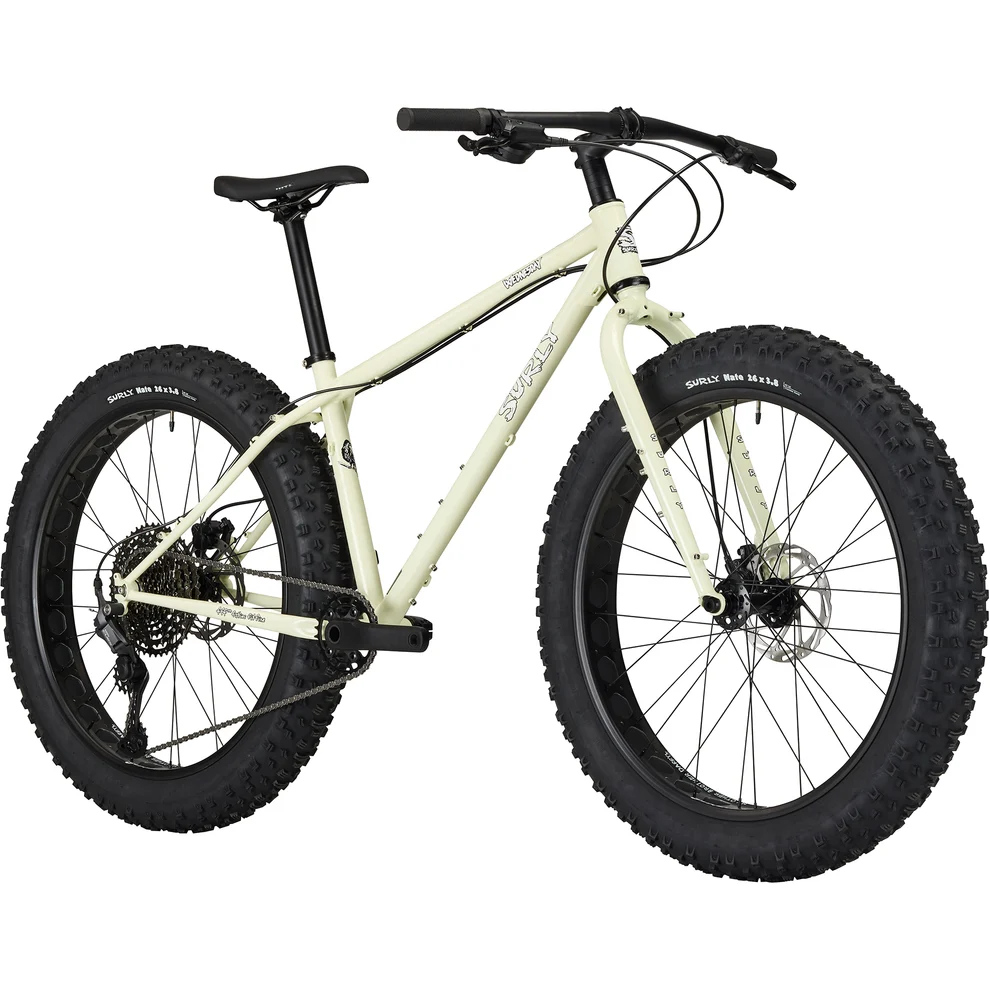
Wednesday is probably the most versatile of the three.
It brings together elements of trail mountain bikes and touring bicycles. Its steel frame, luggage mounts, dropper-post compatibility and configuration options make it a platform for many different uses.
With the current build's Nate 26×3.8″ tyres, it can tackle trails, unpaved tracks, snow and sand, depending on conditions.
The frame also allows larger rear tyres, up to 26×4.6″ under the conditions specified by SURLY, with the rear axle in the appropriate position. Other wheel diameters are also possible, subject to compatibility.
That does not mean every conceivable combination will fit automatically. It means the design offers useful scope for adaptation.
Wednesday can therefore be chosen for a winter trip and continue to be ridden for bikepacking, local exploration and trail riding.
It is the natural starting point when you want a fat bike without focusing your entire choice on the most extreme conditions.
Explore the SURLY Wednesday at Bikejamming
Ice Cream Truck: a fat bike that loves trails
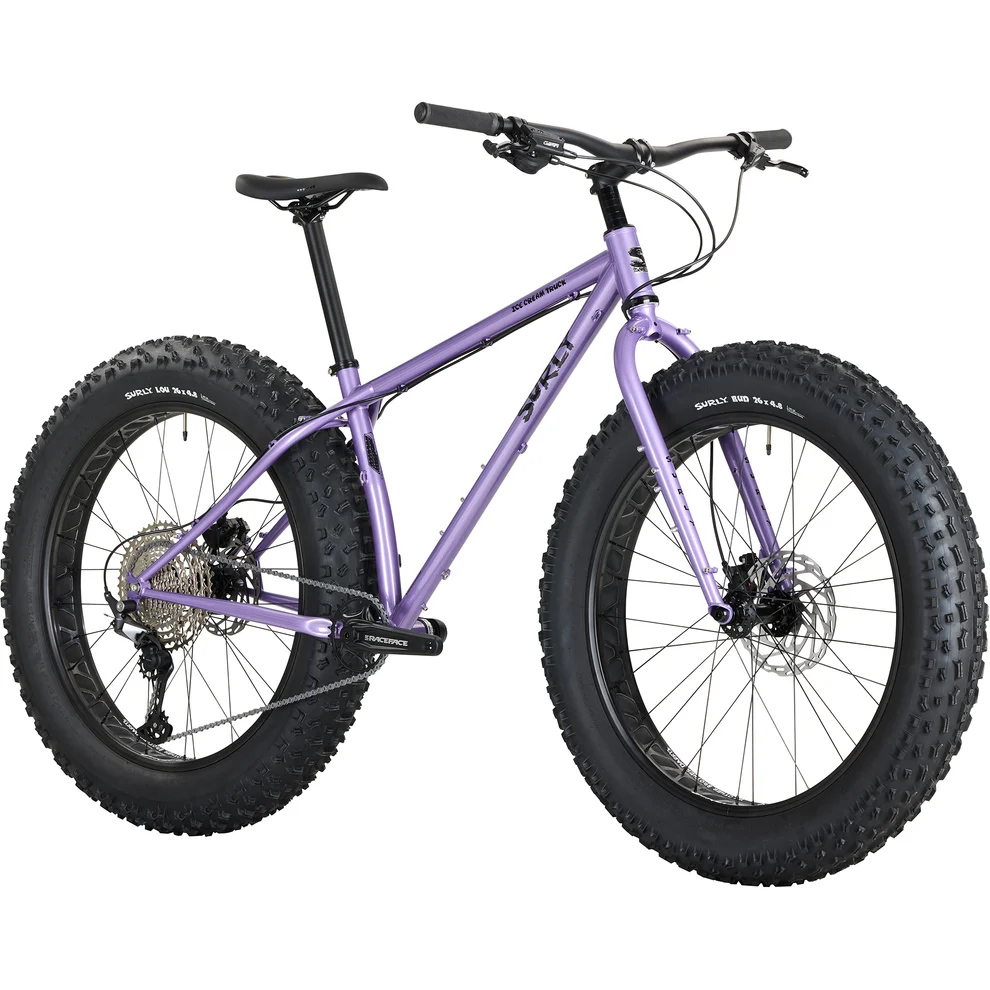
Ice Cream Truck gives the fat-bike concept a more pronounced trail personality.
Its standard 26×4.8″ tyres provide substantial volume, while the geometry is designed for control and manoeuvrability on technical routes.
It makes plenty of sense away from snow: rough trails, loose ground, rocky sections and routes where traction is an important part of the experience.
The possibility of fitting different wheel setups, including 29×3″ according to SURLY's specifications, broadens its potential further.
A conversion naturally requires compatible parts and a realistic assessment of the cost. It is not necessary in order to enjoy the bicycle.
But it is useful to know that the platform is not defined exclusively by its standard fat-wheel configuration.
Mattia Dalvit's Baja California experience illustrates precisely this: changing the wheels altered the balance between sand capability, rolling efficiency and trail handling.
Ice Cream Truck is especially appealing to riders who want to enjoy the act of riding trails, not simply reach difficult places.
Explore the SURLY Ice Cream Truck at Bikejamming
Moonlander: exploring terrain that changes how you ride
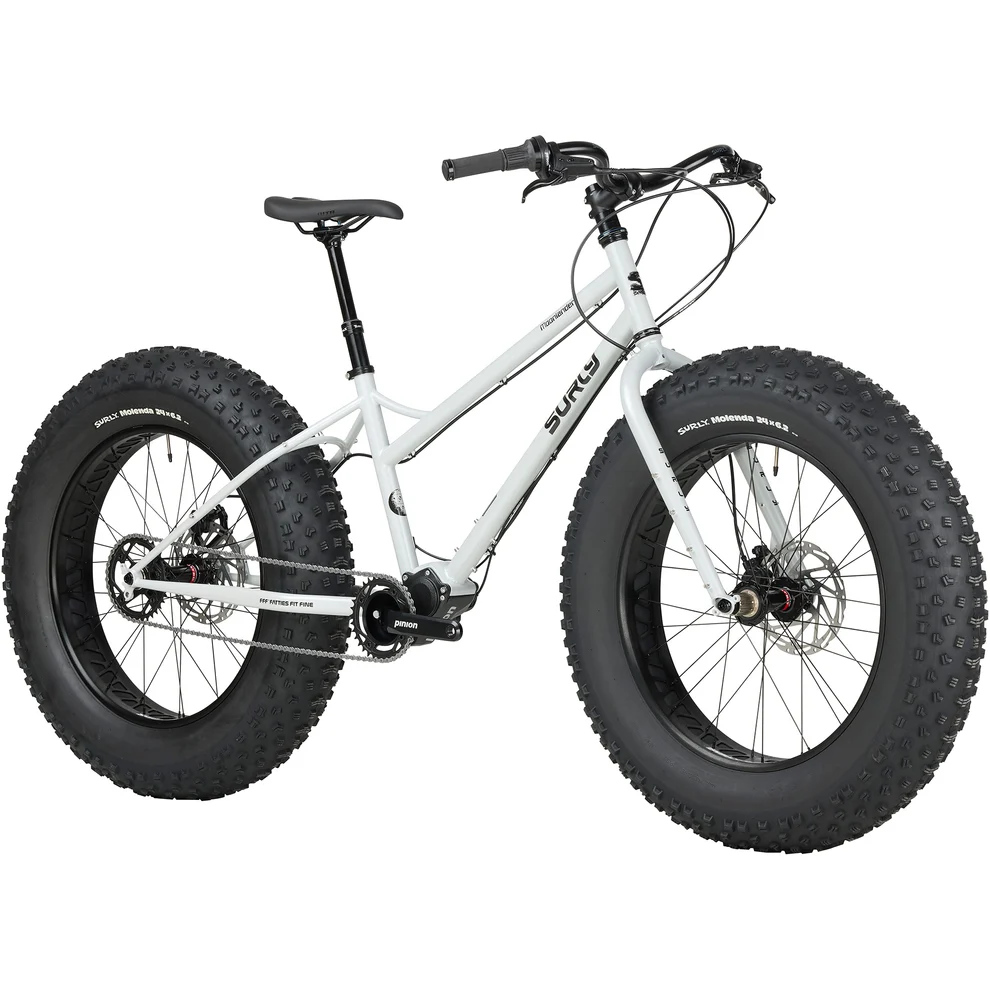
Moonlander is the most specialised of the three, but specialised does not necessarily mean single-purpose.
Its Molenda 24×6.2″ tyres, 100 mm rims, extended rear end and Pinion gearbox form a system designed for ground where flotation and forward progress are the central challenges.
Deep snow, soft sand, sandy riverbeds, rocks and extremely uneven surfaces are the environments that best explain its character.
In his 2024 test, Neil Beltchenko deliberately sought difficult terrain to challenge the new Moonlander. He found remarkable capability on the most demanding surfaces, but also less natural handling on tight singletrack and fast, flowing sections.
Moonlander can also be ridden on other surfaces, and the platform accepts different wheel configurations within the manufacturer's specifications. It remains, however, a bike built around a clear idea: making surfaces rideable that would often bring progress to a halt.
You do not need to plan a polar expedition to appreciate it. What matters is an interest in a style of exploration where challenging ground is part of the experience.
Moonlander is a choice of character, even before it is a choice of tyre size.
Wednesday, Ice Cream Truck or Moonlander: how to choose
Once you have considered terrain, tyres, geometry and luggage, the decision can become clearer.
You do not need to know every journey you will ever make. It is more useful to identify the experiences that appeal most and the kind of bike you want to ride.
Choose Wednesday if you want a fat bike for varied uses: touring, trails, snow, sand and bikepacking. It is particularly interesting if you want to explore without basing your entire decision on the most specialised conditions.
Choose Ice Cream Truck if you place greater emphasis on trail handling, control and tyre volume, while retaining the ability to tackle soft ground and travel with luggage. Its trail-oriented character is unmistakable.
Choose Moonlander if you want a very particular ability to keep moving, and are willing to accept more specialised geometry and components. It is designed for riders drawn to terrain where a conventional fat bike may reach its limits.
But the choice should not become a restriction.
Wednesday can tackle demanding routes. Ice Cream Truck can travel with luggage. Moonlander can deliver rewarding experiences well away from deep snow.
Their main design priorities help guide the choice; they do not exhaust what each bicycle can do.
When a fat bike is not necessary
The ability to ride over snow and sand does not make a fat bike the most efficient option for every route.
On tarmac, firm gravel and long, fast transfers, a gravel bike, conventional mountain bike or plus-tyre platform may offer a different balance of weight, rolling resistance and handling.
But efficiency is not the only reason to choose a bicycle.
You might buy a fat bike for the pleasure of riding it, for traction, for the opportunity to explore different surfaces or simply because you like its character.
The question, then, is not whether a fat bike is essential for every kilometre.
It is whether the possibilities it offers match the way you want to ride.
Frequently asked questions about fat bikes
Is a fat bike only useful for riding on snow?
No. Fat bikes can be used on sand, gravel tracks, trails, loose ground and uneven surfaces. Their behaviour depends on tyres, pressure, geometry and setup. Models such as Wednesday and Ice Cream Truck are also designed for trail and adventure riding.
What is the difference between 3.8″ and 4.8″ fat-bike tyres?
The difference is not just width. A higher-volume tyre can allow lower pressures and potentially better support on yielding ground, but the outcome also depends on casing, rim, tread and load. Bikes with different tyre sizes may also have very different geometry and handling.
What tyre pressure should I use on snow or sand?
There is no universal figure. Consider the tyres, rims, rider weight, luggage and surface conditions. Adjust pressure gradually, observing sinkage, traction, steering precision and casing support, always staying within the components' limits.
Is a fat bike suitable for bikepacking?
Yes. Many fat bikes have mounts for racks, bags and accessories. They can be particularly useful when a trip involves soft or very rough ground. Weight distribution, gearing and spare-parts availability all deserve attention.
Can I ride a fat bike all year round?
Certainly. The possibilities depend on the platform. Wednesday and Ice Cream Truck are also intended for trail and adventure riding without snow. Moonlander is more specialised but not restricted to winter. Some frames also support alternative wheel configurations, subject to individual compatibility checks.
Is Moonlander better than a conventional fat bike?
Not across the board. Moonlander's 24×6.2″ system is especially interesting on extremely yielding ground, but it comes with distinctive geometry, weight and component considerations. On firm trails or mixed routes, a more conventional fat bike may better suit the intended use.
Can I ride a fat bike on any beach or winter trail?
No. A bicycle's technical capability does not override access regulations. On beaches, dunes, protected areas and winter trails, local rules must be respected. Information from route managers is particularly useful for checking permitted trails and current conditions.
The right fat bike is the one that opens up new routes
You should not choose a fat bike solely with the most difficult terrain it might ever encounter in mind.
Choose it for what you want to do: explore trails throughout the year, travel over changing surfaces, ride on snow, cross long sandy sections or seek out terrain that calls for an unconventional bicycle.
Wednesday, Ice Cream Truck and Moonlander offer three different answers, each balancing versatility, handling and specialisation in its own way.
Understanding pressure, tyres, geometry and luggage does not mean turning every ride into a technical exercise. It means learning to get more from your bicycle, adapt it to the route and recognise new possibilities.
Tell us where you would like to ride.
A journey through snow, a sandy route, new trails to explore, or simply the wish to discover what a fat bike can offer throughout the year.
Tell us how you imagine using your bicycle: we will help you work out whether Wednesday, Ice Cream Truck or Moonlander best suits your needs, taking into account terrain, distances, luggage and riding style.
Because a travel bicycle should not be chosen solely for what it can overcome, but also for everything it allows you to discover.
Terrain. Distance. Load. The bike comes afterwards.